EV Charging Scandal: Embezzlement and Idle Stations
Government EV Charging Project Faces Criticism Over Mismanagement and Waste
A government-backed initiative aimed at expanding electric vehicle (EV) charging infrastructure has come under scrutiny for poor management and significant financial waste. The project, which provides substantial subsidies to install public EV charging stations, has been found to have left hundreds of chargers unused and involved cases of embezzlement.
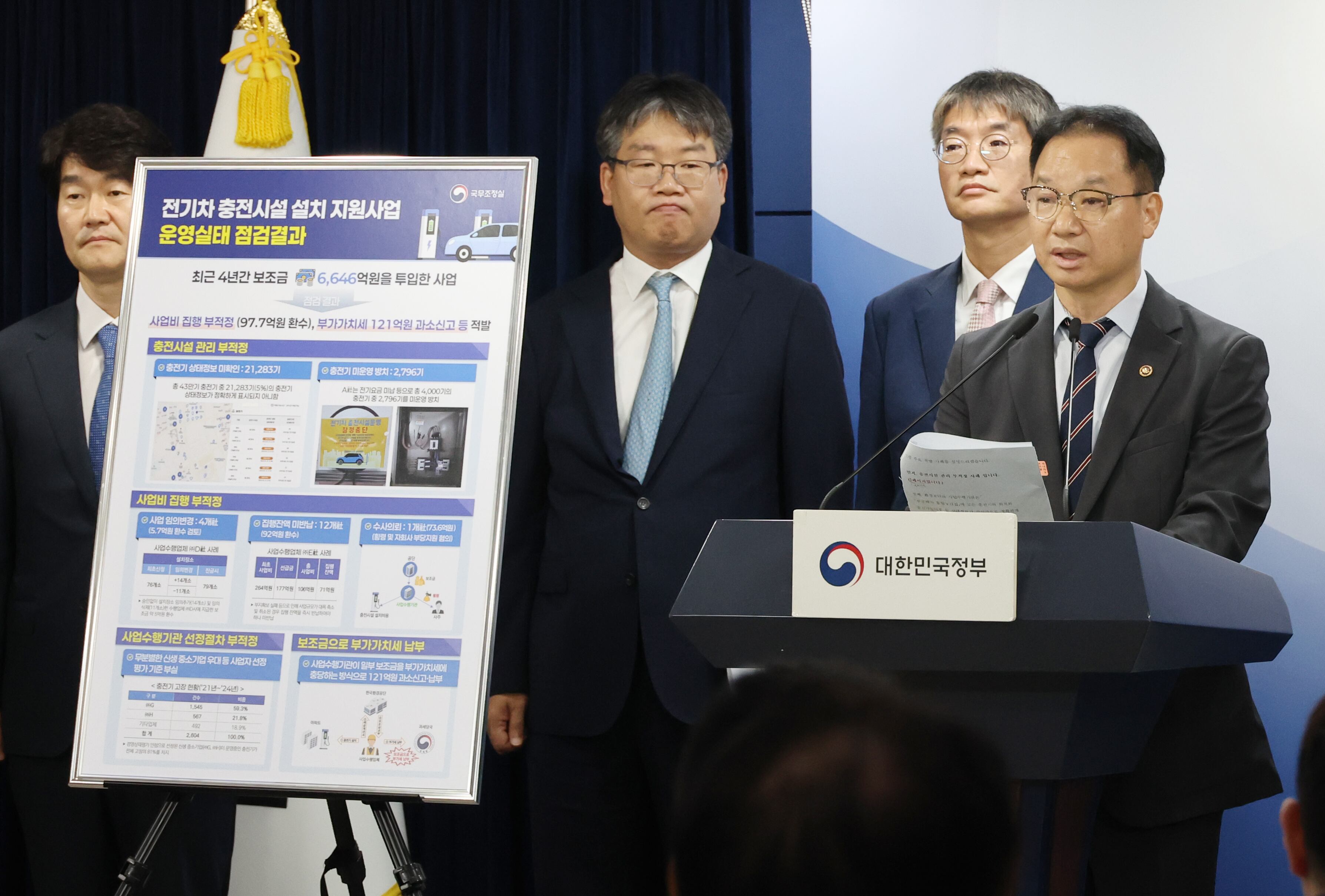
According to a review by the Office for Government Policy Coordination Government Joint Anti-Corruption Prevention Task Force, 2,796 EV chargers installed with government subsidies were left unused for over a year. This issue was attributed to financial difficulties faced by one company, which failed to pay electricity bills despite receiving subsidies. The company did not take any steps to resolve the problem, such as paying overdue bills or selling the equipment.
Financial Subsidies and Their Impact
The government has been offering subsidies to support the installation of EV charging stations. These subsidies cover up to 75 million won per fast charger and 3.5 million won per slow charger. In recent years, the funding has increased significantly:
- 194.5 billion won in 2022
- 292.5 billion won in 2023
- 401.5 billion won in 2023
- 618.7 billion won planned for this year
A comprehensive review of the 664.6 billion won in subsidies distributed from 2020 to 2023 revealed several issues. One major concern was that some companies received advance payments but failed to install the chargers. For example, 9.2 billion won remained unreturned for 29 projects where chargers were not installed. Additionally, 5.9 billion won was still unreturned even after an investigation concluded.
Embezzlement and Fraudulent Practices
Company B was found to have misused 7.36 billion won out of the 17.7 billion won in advance payments it received. Instead of purchasing chargers directly from manufacturers, the company established a subsidiary to buy the equipment, thereby profiting from the price difference. This fraudulent activity led to the referral of Company B and its representative to investigative authorities for alleged breach of trust, violation of subsidy laws, and unfair trade practices.
Another issue identified during the review was the lack of updates on the status of many EV chargers. Despite real-time updates being available on the ‘Zero-Emission Vehicle Integrated Website,’ 21,283 chargers had not been updated in terms of their operational status. This lack of transparency raised concerns about the reliability of the data provided to the public.
Selection Process and Contract Violations
The selection process for companies receiving subsidies also came under scrutiny. Companies C and D, which were newly established small businesses, received full marks in the 'management status' evaluation, allowing them to secure subsidies for slow charger installations in 2022. However, these companies were responsible for a significant number of charger malfunctions—2,112 out of 2,604 reported cases over the past four years.
Moreover, businesses that violated contractual obligations were supposed to face disadvantages in future selections. However, the Korea Environment Corporation and the Korea Automobile Environmental Association failed to impose penalties on these companies, undermining the integrity of the selection process.
Government Response and Future Measures
In response to these findings, the task force and Ministry of Environment ordered the Korea Environment Corporation and the Korea Automobile Environmental Association to inspect all non-operational chargers marked on the website. They also demanded that points be deducted from businesses with many chargers whose status information is not updated in real time during future selections.
Additionally, the government called for the immediate recovery of advance payments held by businesses that have not installed chargers. The task force emphasized the need for more transparent and strict management of the EV charging facility installation support project.
Kim Young-soo, First Vice Minister of State Affairs at the Office for Government Policy Coordination, stated, “Based on the results of this inspection, the government will manage the EV charging facility installation support project more transparently and strictly, and through continuous system improvements and thorough post-management, we will do our best to ensure that citizens can safely and conveniently use EV charging facilities.”


Comments
Post a Comment