Extraordinary Lava Display as Kilauea Erupts in Hawaii
The Spectacular Eruption of Kilauea Volcano
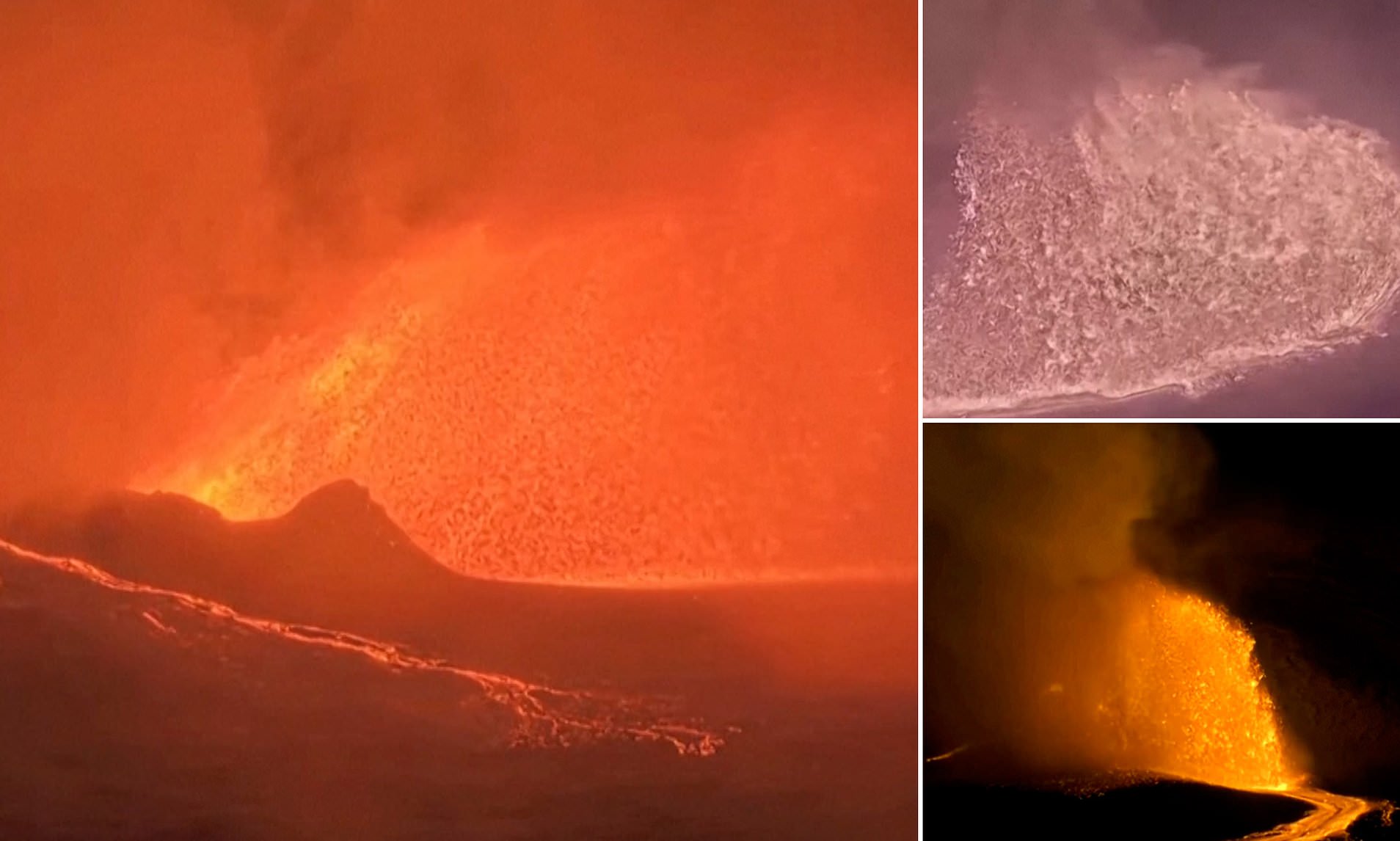
Hawaii’s Kilauea volcano recently erupted in a stunning display, with molten lava shooting up to 100 feet into the air. This event captivated onlookers who were fortunate enough to witness the powerful spectacle. As one of the world's most active volcanoes, Kilauea has experienced 31 eruptions since December, marking it as a significant natural phenomenon.
This particular eruption is only the fourth time in 200 years that Kilauea has produced lava fountains in repeated episodes. Previous instances occurred in 1959, 1969, and 1983. The north vent at the summit crater began spattering early on Friday morning, followed by an overflow of lava later in the day, resulting in dramatic lava fountains during the afternoon.
Importantly, the eruption was contained within the summit crater, ensuring that no homes were threatened. Lucky tourists and locals gathered at Hawaii Volcanoes National Park for a front-row view of this natural spectacle. Park Service volunteer Janice Wei, who regularly captures footage of Halemaumau Crater, described the experience as sitting in the front row at nature's most extraordinary show. She noted that when the molten rock shoots high, it sounds like a roaring jet engine or crashing ocean waves, and she can feel its heat from over a mile away.
According to native Hawaiian tradition, the crater is considered the home of the volcano goddess Pele. Kilauea is located on Hawaii Island, the largest of the Hawaiian archipelago, approximately 200 miles south of Honolulu. Ken Hon, the lead scientist at the Hawaiian Volcano Observatory, explained the mechanics behind the eruption. He mentioned that a lower magma chamber under Halemaumau Crater is receiving magma directly from the earth's interior at a rate of about 3.8 cubic meters per second. Magma has been using the same pathway to rise to the surface since December, making the initial release and subsequent episodes part of the same ongoing eruption.
Many of these eruptions have featured lava soaring into the air, sometimes exceeding 1,000 feet. The fountains are generated because magma, which contains gases that are released as it rises, travels through narrow, pipe-like vents. Hon humorously compared the work of scientists to being ants crawling on an elephant trying to figure out how the elephant works.
Scientists remain uncertain about how the current eruption will conclude or how it may evolve. In 1983, magma built enough pressure that Kilauea opened a vent at a lower elevation, leading to continuous lava leakage rather than high eruptions. The eruption continued in various forms for three decades before ending in 2018. A similar scenario could occur again unless the current eruption stops at the summit if its magma supply diminishes.
With the help of sensors around the volcano that detect earthquakes and subtle changes in ground angle, scientists can estimate when lava is likely to emerge a few days or even a week in advance. Steve Lundblad, a University of Hawaii geology professor, noted that although the lava fountains have been shorter lately, "we're still gonna have spectacular eruptions - they're just going to be wider and not as high."
Hawaii Volcanoes National Park spokesperson Jessica Ferracane emphasized the importance of safety measures for visitors. She advised anyone interested in witnessing the eruption to sign up for US Geological Survey alert notifications, as the eruption "could be over before you know it." Ferracane also urged visitors to stay on marked trails and overlooks due to unstable cliff edges and cracks that may not be immediately apparent, posing risks of serious injury or death. Volcanic gas, glass, and ash can also be hazardous, and nighttime visitors should bring a flashlight.
Ferracane's advice comes after a major rescue operation was launched in June following a tourist falling off a cliff while attempting to get a closer look at Kilauea. The number of tourists visiting Hawaii Volcanoes National Park has increased every month so far, partly due to the eruption. For example, April saw a 49% increase in visitors compared to the previous year.
Hawaiian officials warn visitors about the potential health risks associated with proximity to eruptions releasing toxic gases. According to the Centers for Disease Control and Prevention (CDC), volcanic gas and ash can irritate the eyes and respiratory system, causing symptoms such as vomiting, dizziness, headaches, difficulty breathing, visual disturbances, and tremors. Long-term exposure can lead to lung infections and respiratory disorders.
While some may view lava flows as destructive, Huihui Kanahele-Mossman, executive director of the Edith Kanaka'ole Foundation, sees them as a natural resource that hardens into land, forming the foundation for everything on Hawaii Island. Kanahele-Mossman's nonprofit organization honors her grandmother, a respected practitioner of Hawaiian language and culture. She has visited the crater multiple times since the eruption began, delivering chants and placing offerings, including awa and a fern lei.
"To be able to actually see that eruption that's described in the stories, that's always exciting to us and drives us and motivates us to stay in this tradition," she said, highlighting the cultural significance of the natural phenomenon.


Comments
Post a Comment