EU generates 35.3kg plastic waste per person annually: Which nation recycles the most?
EU Countries Leading in Recycling Efforts
The European Union has unveiled its top recyclers, showcasing several countries that have exceeded waste reduction targets ahead of the 2030 goal. According to new data from Eurostat, the EU generated nearly 80 million tonnes of packaging waste in 2023, equating to 177.8kg per inhabitant. While this represents an 8.7kg decrease compared to 2022, it is still 21.2kg higher than in 2013.
Packaging waste includes materials used for containing, handling, delivering, or presenting goods. This category encompasses items such as glass bottles, plastic containers, aluminium cans, food wrappers, timber pallets, and drums.
In terms of composition, 40.4% of all packaging waste came from paper and cardboard, followed by plastic (19.8%), glass (18.8%), wood (15.8%), metal (4.9%), and “other packaging” (0.2%).
The EU’s Top Recyclers
In 2023, seven EU countries met the 2030 target of recycling a minimum of 70% of all packaging waste. Belgium led the way with an impressive rate of 79.7%, likely driven by its “pay-as-you-throw” waste collection system. This initiative, implemented since 1995, charges households based on the amount of mixed or residual waste they produce.
The cost varies by region, with residents in the Flanders area paying around 23 cents per kilo of household waste. Additionally, the European Environment Agency (EEA) notes that a voluntary deposit-return system exists for specific reusable packaging, such as glass beverage bottles and industrial containers.
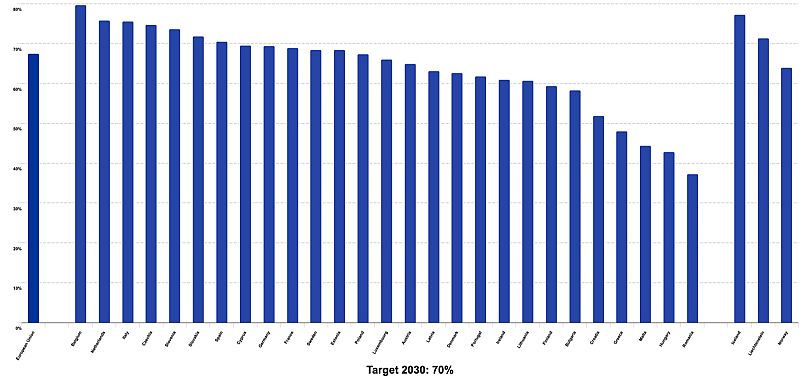
The Netherlands ranked second with a 75.8% waste recycling rate, followed by Italy (75.6%), Czechia (74.8%), Slovenia (73.6%), Slovakia (71.9%), and Spain (70.5%). However, Romania lagged significantly behind, recycling only 37.3% of packaging waste in 2023.
The European Parliament highlights that countries with lower GDPs historically struggle with low recycling rates due to the challenges of developing efficient and sustainable waste management systems.
Plastic Carrier Bags in the EU
The EU’s Plastic Bags Directive aims to reduce the consumption of lightweight carrier bags (LPCBs) to less than 40 per inhabitant by 2025. This has prompted many supermarkets and retailers to offer reusable bags with thicker walls.
Belgium topped the list with just four plastic bags per capita in 2023, followed by Poland (seven bags per capita) and Portugal (14 bags per capita). However, several countries are still far from meeting the target. Latvia recorded an alarming 209 plastic bags per capita in 2023.
Why Reducing Waste Matters
According to the EEA, waste can have severe negative impacts on human health and the environment. Burning waste, rather than reusing it, contributes to increased air pollution, while expanding landfill sites pose risks of water and land contamination.
“Overall, the EU is slowly showing improvement toward recycling more and landfilling less,” the EEA states. “Still, achieving the EU’s waste objectives requires significant effort. Non-recyclable products need to be phased out, and waste should be collected separately so it can be recycled.”
Approximately 90% of EU waste is treated domestically, but large amounts are still exported—mainly for recycling. This practice has raised concerns about worsening pollution in poorer countries.


Comments
Post a Comment