Five Hundred Drone Sightings Reported in Denmark
Escalating Tensions: Drone Attacks and the Threat of Conflict
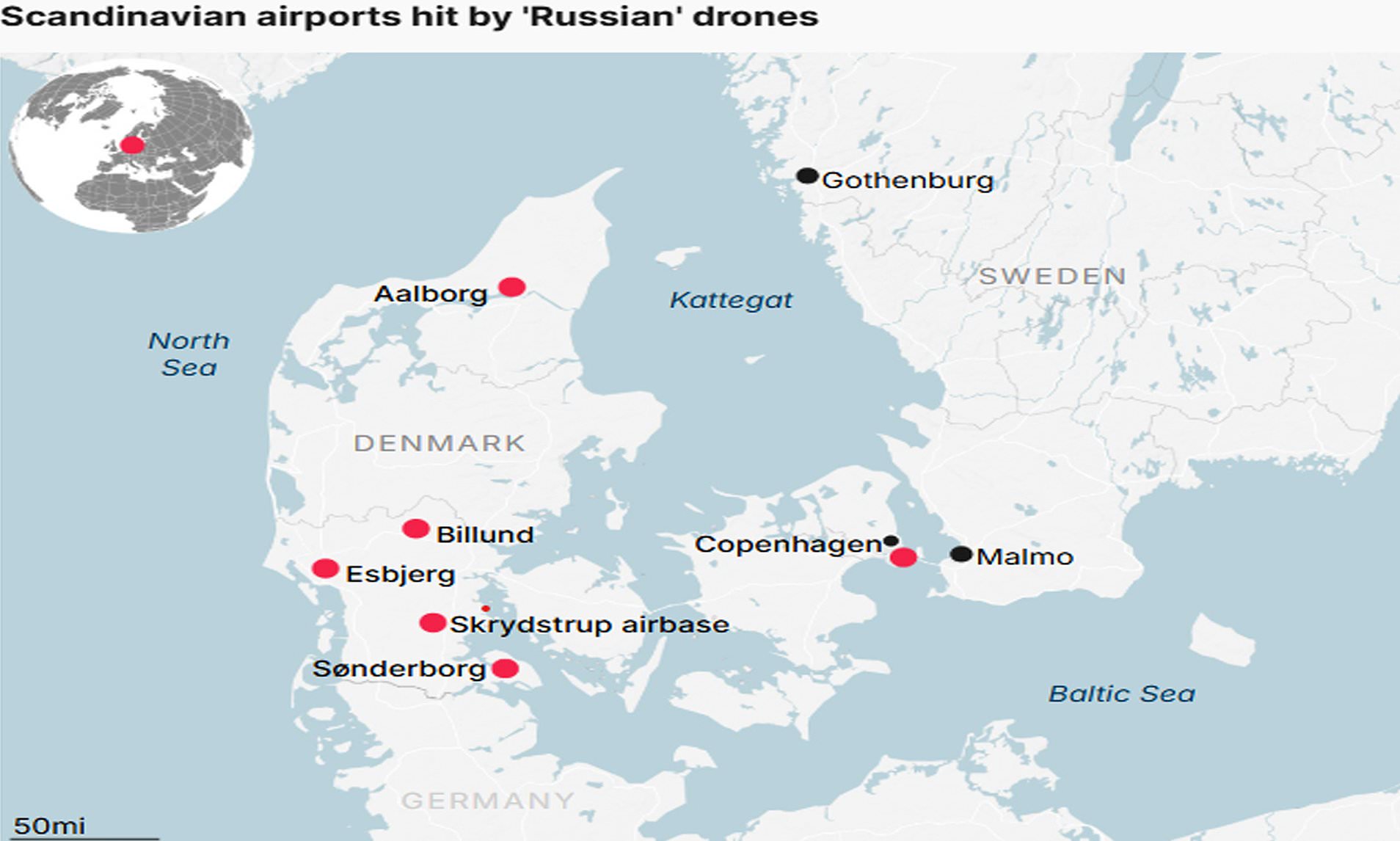
In recent days, a wave of drone attacks has swept across Scandinavia, sparking widespread fear and concern among the public in Denmark. Over 500 possible sightings have been reported in just 24 hours, with officials describing the incidents as a 'systematic operation' and a 'hybrid attack'. These events have led to the temporary closure of two major airports, disrupting flights and stranding thousands of passengers.
This is not the first such incident. A similar disruption occurred just two days prior, when drones caused chaos at Copenhagen airport, affecting around 100 flights. The repeated nature of these attacks has raised questions about who is behind them. While the police have yet to confirm any of the reports, they are urging citizens to remain vigilant and report any suspicious activity with detailed descriptions.
As European nations grapple with this growing threat, ministers are working on plans for a continent-wide 'drone wall' to counter what many believe are Russian aerial incursions. This initiative comes as the Kremlin warns that any strike on its aircraft could lead to direct conflict with NATO.
A Continent on Edge
Several countries, including Denmark, Finland, Poland, and the Baltic states, are set to join Ukraine at a summit to discuss strategies for strengthening defense. EU Chief Ursula von der Leyen has described this effort as 'the bedrock of credible defence.' However, the situation remains tense, with Russia accused of launching a campaign of hybrid attacks across Europe, exposing vulnerabilities in the continent's airspace.
Poland, which has already shot down several Russian drones in recent weeks, has vowed to take action against any hostile objects over Ukraine under fast-tracked laws. However, the escalation continues, with Russia's ambassador to France warning that shooting down its planes would be considered an act of war. Meanwhile, the country's foreign minister has accused NATO of waging 'real war' on it and claimed the organization is directly involved in its conflict with Ukraine.
Challenges in Detection and Response
European officials are working to develop joint systems for detecting and destroying drones that threaten civilian and military infrastructure. The European Commission has indicated that the cost of such a system could be covered by its €150bn Security Action for Europe loans scheme. However, the challenge of spotting drones remains significant. Commission spokesman Thomas Regnier noted that detecting these small, advanced drones is no easy task.
The Danish defense minister, Troels Lund Poulsen, has confirmed that the country has been targeted, with multiple airports disrupted on the same night. Aalborg airport, used for both commercial and military flights, was forced to shut for three hours, while Billund airport was closed for an hour. Drones were also seen near other airports and military facilities, raising concerns about the scale of the threat.
Poulsen emphasized that the systematic nature of the attacks points to a professional actor, describing the incidents as a 'hybrid attack using different types of drones.' He warned that the technology involved is constantly evolving, making the situation even more challenging.
Diplomatic Tensions and Military Posturing
Denmark's prime minister, Mette Frederiksen, has spoken with NATO Secretary General Mark Rutte about the serious situation related to drones over Danish airports. Rutte stated that NATO allies and Denmark are working together to ensure the safety and security of critical infrastructure.
Meanwhile, the threat of escalation has become more pronounced. Polish Prime Minister Donald Tusk has warned that the current situation brings Europe closer to open conflict than at any time since World War Two. He has made it clear that Poland will act if its skies are violated, stating that there is 'absolutely no discussion about that.'
Earlier this month, Poland shot down three Russian drones that crossed into NATO territory, marking the first such action since the full-scale invasion of Ukraine began in 2022. However, Tusk also stressed the need for caution in ambiguous cases, emphasizing the importance of careful decision-making to avoid triggering a severe conflict.
A Growing Sense of Crisis
The sense of crisis has spread across Europe. Estonia reported the entry of three Russian fighter jets into its skies, while Romania said one of its border areas was struck by a drone. European officials have called these moves deliberate provocations intended to unsettle NATO. With peace efforts stalled, many fear that the conflict in Ukraine could spill over into neighboring countries at any moment.
Britain has also been drawn into the situation, with the Royal Navy dispatching HMS Iron Duke and a Wildcat helicopter to monitor Russian vessels in the English Channel. Defense Minister Luke Pollard stated that the Royal Navy protects the UK 24/7, monitoring Russian movements and ensuring the security of waters and undersea cables.
Across Europe, officials believe the Kremlin is deliberately walking a tightrope, staging incidents that fall short of an outright attack but still force NATO to respond. As tensions continue to rise, the region remains on high alert, with the potential for further escalation ever-present.


Comments
Post a Comment