Ginkgo Gender Fight: Cities Remove Female Trees Over Smell Controversy
The arrival of autumn is often marked by a distinct scent, one that carries the weight of history and transcends geographical boundaries. In cities like Seoul, this aroma is closely tied to the ginkgo trees lining the streets. These ancient trees, known for their resilience and beauty, have become a symbol of the season. However, their presence is not without challenges, particularly when it comes to the fruits they produce.
Ginkgo Trees in Gangnam-gu
Gangnam-gu, one of the most densely wooded areas in Seoul, is home to the highest number of street trees. Among these, ginkgo trees are the most prevalent, with 6,946 of them, 30% of which are female. Female ginkgo trees produce fruits that fall from the trees, creating a mess and an unpleasant odor. The annual accumulation of these fruits amounts to 4 tons, prompting local authorities to take action.
A representative from Gangnam-gu explained, "While we quickly clean up the fallen fruits, budget and manpower constraints have forced us to address the issue at its source. Since two years ago, we have been replacing female ginkgo trees with male ones. This year alone, we removed 115 female ginkgo trees along Seolleung-ro and Iwon-ro and replaced them with male trees." This strategy aims to prevent fruit formation, thereby eliminating the odor associated with the fruits.
Eliminating Ginkgo Fruits in Northern Seoul
In contrast, Gangbuk-gu has taken a more aggressive approach. There are currently zero female ginkgo trees among the street trees in this district. A source from the district office stated, "We replaced all 1,053 female ginkgo trees along roadsides (excluding parks) with male trees. As ginkgo fruits disappeared from the streets, odor-related complaints vanished."
The Seoul Metropolitan Government has launched a comprehensive campaign since August to tackle the inconvenience caused by ginkgo fruits in autumn. Methods such as "ginkgo harvesting," which involves collecting fruits before they ripen and fall, are being used. However, the most effective solution remains the complete removal of female trees. Through budget support, the number of female ginkgo trees in Seoul has decreased from approximately 31,000 in 2016 to 25,127 last year.
Nationwide Efforts to Address Ginkgo Fruits
The issue of ginkgo fruits is not confined to Seoul. It is a nationwide concern. Last year, Gimhae City in Gyeongnam Province even changed its municipal tree from ginkgo to chaste tree. While fruits were once collected and donated to senior centers, many now refuse them due to concerns about pesticides and heavy metals, leading to their disposal as waste. This has prompted local governments across the country to focus on "female tree eradication."
Daejeon, for instance, planted 926 male trees this year, completely eliminating female ginkgo trees in Dong-gu and Jung-gu. Over the past three years, a total of 2,500 trees were replaced, achieving a 70% replacement rate citywide. A city source explained, "Since male and female ginkgo trees are indistinguishable by appearance, we mark trees that bore fruit the previous autumn with paint." Incheon’s Michuhol-gu also installed identification tags on female trees this year.
Controversies Surrounding Gendered Labels
An unexpected controversy emerged in 2020 when Manan-gu in Anyang City decided to attach "♀" tags to female trees. This move faced significant backlash from women's and environmental groups, who criticized it as "stigmatization that labels female trees as harmful and to be avoided by associating them with odor and malice." They argued that the policy reflected a lack of gender sensitivity and framed femininity as something to be controlled.
Trunk injections, another method used to suppress fruit production, also drew criticism. Women's and environmental groups questioned whether female trees should be subjected to such treatments simply for being female. They recommended deploying public workers during harvest season to collect fruits before they fell.
Ginkgo Trees on the Operating Table
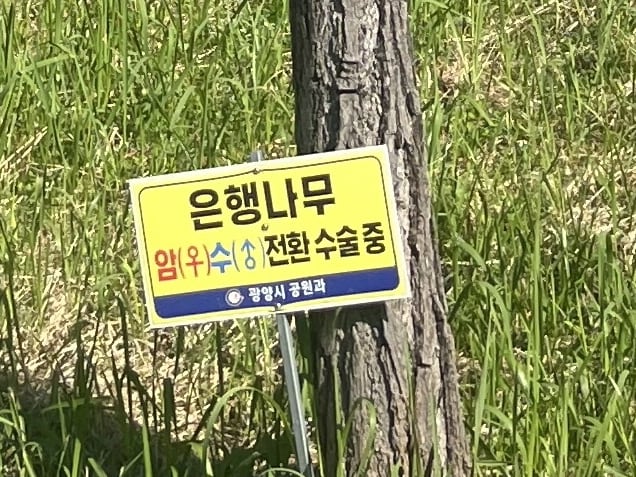
In Gwangyang City’s Usan Well-being Theme Park, a sign reads, "Ginkgo Tree Sex Change Surgery in Progress." Using grafting—a technique typically used for plant breeding—male branches are attached to female trees to prevent fruit formation. A source from Gwangyang City said, "Complaints about fallen fruits near walking paths led us to graft male branches onto 26 female trees. The project was completed two years ago, and no fruits have grown since."
Historically, ginkgo trees were planted indiscriminately. Since it takes at least 15 years for a ginkgo tree to reveal its sex after germination, it was a gamble. A legend from the Sinjeung Dongguk Yeoji Seungnam recounts that in the mid-Joseon period, Yun Tak planted two ginkgo trees in the courtyard of Sungkyunkwan. Symbolizing Confucius and Confucianism, they remain the university’s official tree. However, the rotting smell of annual fruits and the noise from cleaners became a nuisance. A frustrated scholar performed a ritual cursing the trees, after which they stopped bearing fruit. Now, such rituals are unnecessary.
After 30 years of research, the National Institute of Forest Science developed ‘Ireum No. 1,’ a fruitless ginkgo tree for urban use. By collecting and propagating 39 diverse specimens, they identified a unique male tree that never bears fruit. They stated, "This is expected to resolve autumn odor issues. Its upward-growing form suits narrow urban spaces." Plans are underway to increase its population and distribute it nationwide. Seoul is also piloting grafting male branches onto female trees, experimenting with three near Jamsil Sports Complex.
Balancing Benefits and Challenges
Despite the annual chaos, ginkgo trees cannot be abandoned due to their exceptional functionality as street trees—air purification, fire resistance, and pest resilience. Replacement costs approximately 1 million Korean won per tree. Replacing 1,000 trees would cost 1 billion Korean won in taxes. Last year, Seongbuk-gu planned to cut down 221 female ginkgo trees and replace them with males. Residents protested, arguing that the money could be better spent on addressing more pressing pollution sources.
Ideas like umbrella-shaped "fruit collection nets" are spreading to prevent fruits from falling. Young male trees planted to replace cut females take 20 years to function as proper street trees. Some question whether the odor issue justifies the financial and social costs of replacement. A source from Chuncheon City, Gangwon-do, said, "Ginkgo trees are massive, and replacing them requires altering sidewalks, making it financially unfeasible. It’s regrettable that people forget the year-round benefits trees provide and cut them down because they can’t tolerate 30 days of odor."


Comments
Post a Comment