Hope Returns: Cyprus President Ready for Reunification Talks
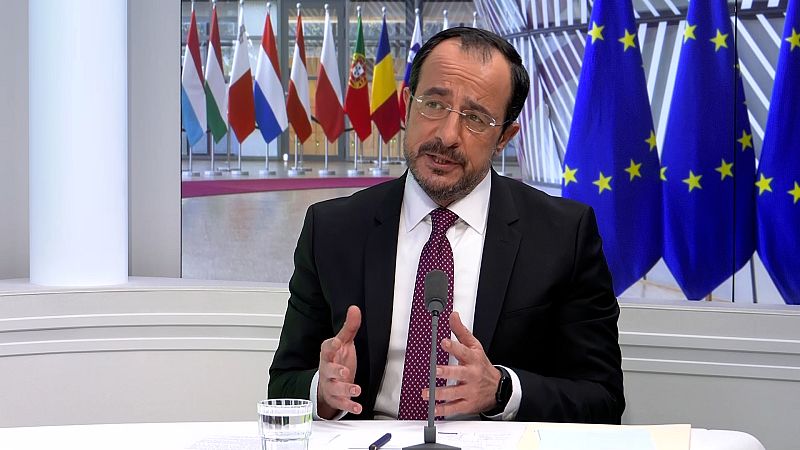
Cyprus has expressed a willingness to restart discussions on the reunification of the island, marking a potential shift after eight years since the last round of UN-backed negotiations collapsed in Switzerland in 2017. Cypriot President Nikos Christodoulides made this statement during an interview on Euronews' flagship programme The Europe Conversation, just two months ahead of the start of the Cypriot EU presidency.
This declaration comes in response to the recent victory of pro-EU Social Democrat Tufan Erhüman as the leader of the Turkish-occupied Northern Cyprus. Erhüman's campaign focused on the reunification of Cyprus under a federal model, reigniting hope for a new attempt to resolve the long-standing dispute. Christodoulides welcomed this development, stating that if Erhüman participates in negotiations and speaks openly about a bi-zonal, bi-communal federation, the path to a solution based on UN Security Council resolutions would be open.
At the same time, Christodoulides rejected the idea of a two-state solution for the island, which has been advocated by Turkish President Recep Tayyip Erdogan. The division of Cyprus, a former British colony in the eastern Mediterranean, has persisted for decades due to tensions between the Greek and Turkish communities. Since 1974, when Turkish forces invaded following a failed coup by supporters of union with Greece, the island has remained split between the internationally recognized Greek Cypriot-controlled Republic of Cyprus and the self-declared entity in the north, recognized only by Turkey.
Despite numerous attempts by the United Nations to mediate, the division remains unresolved. The Republic of Cyprus is part of the European Union, but EU law does not apply in the breakaway northern Cyprus, where a Turkish military presence continues to exist.
EU losing enlargement tool
Christodoulides emphasized the importance of EU enlargement, a topic that has been dormant for years but recently gained renewed attention in Brussels. He stated that enlargement is one of the most important geopolitical tools of the European Union, and he expressed concern that the EU is losing this tool due to unfulfilled promises. Nicosia aims to make progress on accession to the EU during the Cypriot EU presidency, particularly with Montenegro.
If no positive developments occur, there is a risk that candidate countries may lose faith in the EU, potentially leading them to turn to non-EU actors, according to Christodoulides.
Bringing EU closer to Middle East
When Cyprus assumes the rotating EU presidency in January, one of its priorities will be to bring the European Union closer to the Middle East. As the only EU member state in the region, Christodoulides believes his country is well-positioned to assist in implementing US President Donald Trump’s peace plan for Gaza. He outlined a six-point plan to repurpose Cyprus’ 'Amalthea' maritime humanitarian corridor to support Gaza’s reconstruction.
The plan includes humanitarian aid, screening of "dual-use goods," and training of Palestinian security forces. Cyprus also aims to play a role in Trump’s proposed 'international stabilisation force,' which is expected to include Arab and international partners. These initiatives align with eight points of Trump’s broader 20-point plan, covering humanitarian assistance, economic recovery, reconstruction, and future governance.
No end in sight for war in Ukraine
Regarding defense and security in Europe, Christodoulides expressed pessimism about the prospects of ending the war in Ukraine during Cyprus' presidency of the EU Council. He stated that he does not see an end to the conflict, but emphasized the need for continued support for Kyiv and a clear stance against the illegal Russian invasion and occupation of Ukraine.
In this context, Christodoulides announced plans to visit Ukraine in early December, just weeks before the start of the Cypriot EU presidency.


Comments
Post a Comment