New Clinics Focused on Internal Medicine and Orthopedic Surgery

Trends in New Clinic Establishment
Recent data reveals a notable trend in the establishment of new clinics, particularly highlighting a concentration in specific medical fields. Local hospitals and clinics are increasingly focusing on areas such as internal medicine and orthopedic surgery. However, one of the essential medical subjects—pediatric and adolescent medicine—has seen a continuous decline in the number of newly established clinics.
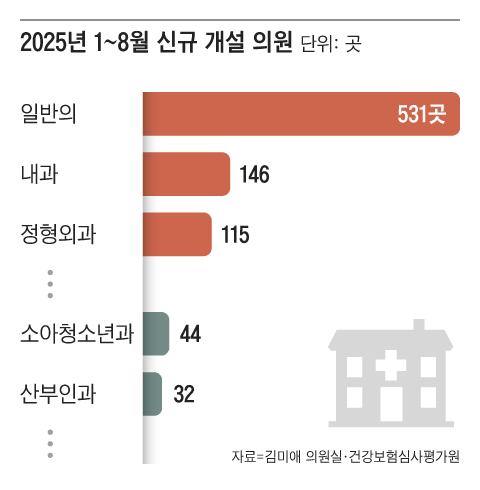
According to an analysis conducted by Rep. Kim Mi-ae from the People Power Party and the Health and Welfare Committee of the National Assembly, based on data from the Health Insurance Review & Assessment Service, general practitioners, internal medicine, and orthopedic surgery have consistently ranked at the top among newly established clinics from 2019 to January-August 2025. For the first eight months of this year, the numbers were 531 general practitioner clinics, followed by 146 internal medicine clinics and 115 orthopedic surgery clinics.
Characteristics of General Practitioner Clinics
Establishing a general practitioner clinic involves opening a hospital under the designation of a 'general practitioner (GP)' who has not obtained specialist qualifications in any particular field. These clinics provide primary care for conditions such as colds and chronic diseases without specializing in a specific department. From the perspective of doctors, there is no need for specialist training; they can start their practice immediately after obtaining a medical license upon graduating from medical school.
This means that new clinics are predominantly being opened by general practitioners, who face lower establishment burdens and can offer comprehensive care. Additionally, internal medicine and orthopedic surgery specialists, who have higher profitability, are also contributing to this trend.
Financial Performance of Different Medical Fields
As of last year, orthopedic surgery clinics claimed an average of 812.65 million Korean won in medical fees per clinic to the national health insurance. Internal medicine averaged 414.82 million, neurosurgery 716.61 million, neurology 516.72 million, and psychiatry 393.11 million. Dermatology clinics claimed an average of 148.88 million Korean won per clinic, which is attributed to the high number of non-insured treatments not covered by health insurance.
Decline in Pediatric and Adolescent Medicine Clinics
In contrast, the number of newly established pediatric and adolescent medicine clinics has been declining. In 2019, there were 114 new pediatric and adolescent medicine clinics, but this dropped to 49 last year. Obstetrics and gynecology saw 49 new clinics, remaining stagnant at 49 in 2024.
Calls for Government Support
Rep. Kim Mi-ae highlighted that the focus on internal medicine, orthopedic surgery, and general practitioners continues to overshadow essential medical departments that are crucial for the public. She emphasized the need for the government and the National Assembly to strengthen incentives and support for the establishment of new clinics in these essential medical fields.
Key Takeaways
- Concentration of New Clinics: General practitioners, internal medicine, and orthopedic surgery dominate new clinic establishments.
- Financial Factors: Orthopedic surgery and other specialties show higher profitability compared to others.
- Decline in Essential Departments: Pediatric and adolescent medicine, along with obstetrics and gynecology, face challenges in new clinic growth.
- Need for Policy Changes: Experts suggest the need for targeted policies to support essential medical fields and ensure balanced healthcare access.


Comments
Post a Comment