The Boyz vs. QWER Legal Light Stick Battle

In the world of K-pop, official light sticks have become more than just merchandise. These interactive items, with unique designs for each artist, serve as symbols of fandom and identity. They are not merely products but talismans that connect fans to their favorite groups. Recently, the controversy surrounding the design of light sticks has sparked intense debate within the entertainment industry.
The dispute between the group THE BOYZ and the girl band QWER has escalated, raising concerns about potential legal conflicts. As tensions grew, various entertainment-related organizations stepped in to mediate, even referencing the "K-pop crisis theory." The Korea Entertainment Producers Association (KEPA) emphasized that this issue is not just about a single item's design but involves the sustainability of the future Hallyu ecosystem, global market competitiveness, and the health of K-pop fandom culture.

THE BOYZ vs. QWER Light Sticks: What’s the Issue?
The controversy began when QWER released a megaphone-shaped light stick ahead of its world tour. THE BOYZ’s fanbase, “The BOYZ,” pointed out that it resembled the heart-shaped megaphone light stick released by THE BOYZ in 2021. THE BOYZ was the first to introduce a megaphone-shaped light stick, and fans argue that the logo on the speaker and the handle position are similar. Additionally, this light stick completed design registration in May 2022 after passing the Korean Intellectual Property Office’s examination, raising concerns about possible design rights infringement.
On the other hand, QWER’s fanbase, “Bawi Ge,” countered that the megaphone is a common design that anyone could think of. QWER’s agency, Three Y Corp. and Prism Filter, stated that there are no issues with the design or copyright. However, THE BOYZ’s agency announced that they had discussed the issue with QWER and requested design changes, though no final conclusion has been reached yet. They also warned of legal procedures to prevent recurrence.
Three Y Corp. and Prism Filter insisted that they have been advised that there are no issues, including copyright infringement, and continued selling the light stick.
Professor Lee Jae-kyung, head of the Korean Entertainment Law Society and a professor at Konkuk University, explained that the most important factor in design rights is how many similar designs have been publicly disclosed before. He noted that the shape of the light stick being a megaphone may seem unique, but whether the front is a heart or a circle is crucial in determining if it can be considered the right of the design applicant.
Concerns Over Damage to K-pop’s Image Due to Light Stick Controversy
The entertainment industry is worried that this light stick conflict could tarnish the positive image K-pop has built. Emotional rifts between fandoms are also growing. THE BOYZ’s fans are digging up the history of some QWER members who previously worked as female BJ streamers, while some QWER fans are leaving threatening comments to THE BOYZ’s fans, attacking each other.
KEPA stated in its statement, “The foundation of K-pop’s creativity, identity, and sustainable growth lies in the respect for intellectual property and mutual trust among artists, fandoms, companies, and the entire cultural industry.” It added, “If each side only confronts legally, the entire K-pop industry will face serious risks, including a decline in creativity, deepening exclusivity and isolation in fan culture, and a loss of trust in domestic and international markets.”
The Korea Management Union also said, “The issue of design similarity and imitation is sensitive. Since intellectual property rights are intangible assets, the boundaries can be ambiguous. We will do our best to help reach an agreement.”

Light Sticks: Symbols of K-pop, Artists, and Fandom Identity
So why does the light stick, which has led to legal threats, hold such significance for fans and entertainment agencies? This is related to K-pop’s characteristic fandom-based passionate cheering culture.
In the 1990s, fandoms cheered for their artists by waving balloons in colors symbolizing the artist—white for H.O.T, orange for Shinhwa, and sky blue for god. At the Dream Concert, where popular artists gather, the number of balloons of a certain color was a measure of a fandom’s influence. Fandoms united around balloons and defined their identity by distinguishing themselves from other fandoms.
The evolution of cheering tools from balloons to light sticks began with the artist Seven. YG Entertainment released a glow stick in the shape of the number ‘7’ as Seven’s cheering tool instead of balloons. Later, BIGBANG released the ‘Bang Bang’ light stick in the shape of a crown symbolizing their fandom ‘VIP,’ starting the culture of waving light sticks with luminescence.

Now, entertainment agencies release light sticks reflecting the artist’s symbol or fandom’s characteristics once the fandom reaches a certain size. BTS’s official light stick is the ‘Army Bomb’ in the shape of a bomb, inspired by their fandom name ‘Army.’ Blackpink’s light stick is the ‘Ppong Stick,’ a heart-shaped mallet. The heart is pink, and the handle is black, reflecting the group’s name. SEVENTEEN’s fandom name is ‘Carat,’ a unit of diamond mass, and their light stick features a diamond. NewJeans’ light stick is the ‘Bingky Stick’ shaped like a rabbit, the artist’s symbol.
Ms. Lee (34), who has been a fan of idols for 16 years, said, “Even if it’s not a concert, I bring the light stick to various schedules. Then the artist sees the fan with the light stick and recognizes, ‘Oh, there are our fans?’ and greets them. Also, since there are many light sticks these days, the more unique the shape, the more pride fans take. The light stick is like a unique identity, so wouldn’t it be unpleasant if they were similar?”

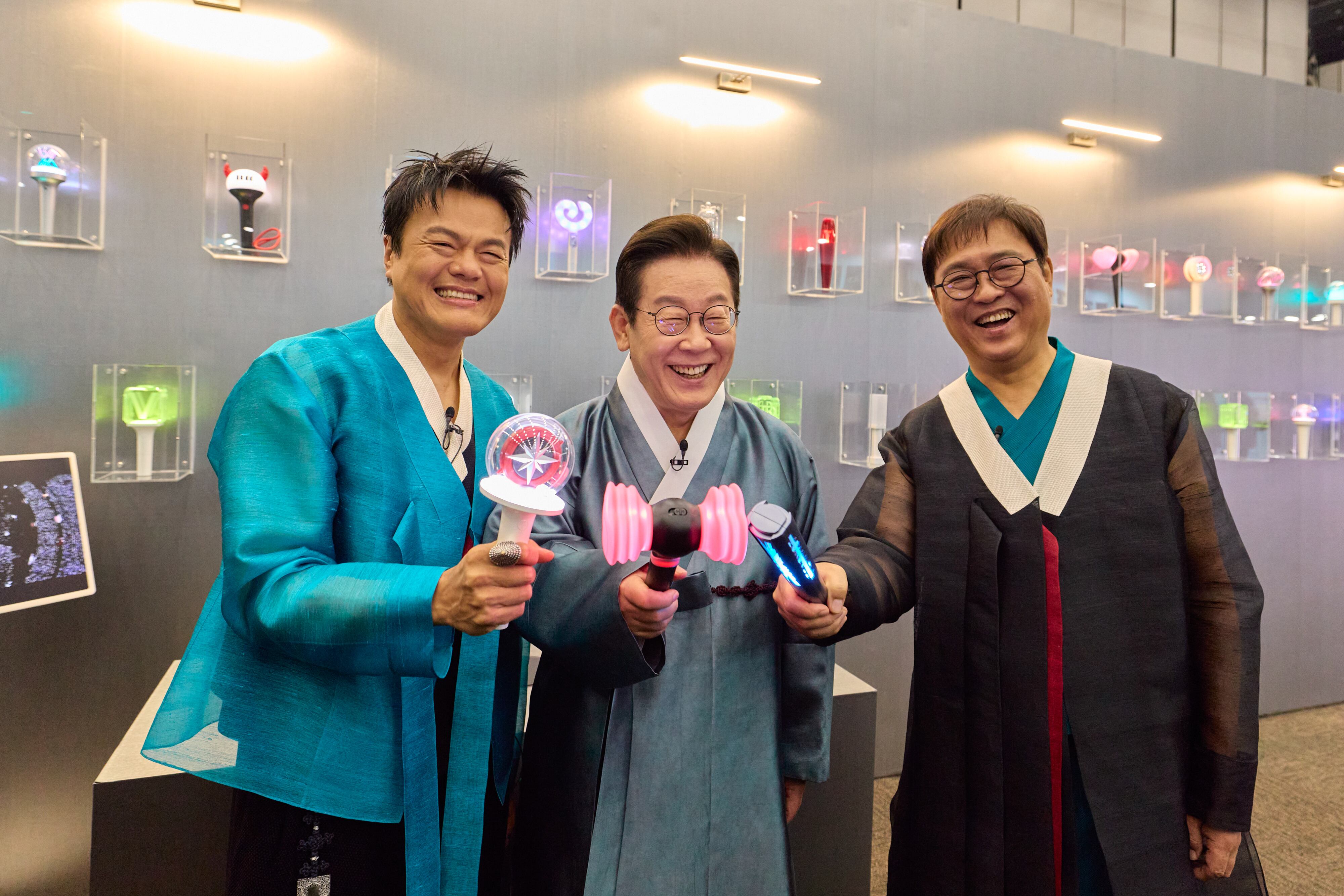
Technology is also advancing. Light sticks now have remote control functions to change their lights in sync with the artist’s song. While fans used to cheer for artists unilaterally by waving balloons, light sticks have become a medium connecting artists on stage with fans in the audience. Park Jin-young, co-chair of the Presidential Committee on Popular Culture Exchange, introduced the light stick to President Lee Jae-myung at the committee’s launch ceremony on the 1st, saying, “In other performances, the audience remains consumers, but in K-pop, the audience is one and the main body of the performance. The message ‘We are one with you’ to the fans is significant. Without it, it becomes the same as other entertainment industries.”

Unwritten Rule: Avoid Similar Colors and Designs
There have been previous conflicts between fandoms over symbolic colors and light sticks. However, artists often mediated their fans, or junior artists avoided similar designs and colors to prevent controversy, meaning to respect each other and avoid futile fights.
In 2015, when the group BTOB set their official color to sky blue, god’s fans protested. At the time, god’s leader Park Jun-hyung wrote on social media, “A symbol is something you give meaning to in your heart and mind, even if it’s not visible. Because the sky blue friends (fans) have existed for so long, the pretty juniors grew up from childhood to now, influenced a lot, didn’t forget their dreams, and ran here. I’m proud. Everyone.” He comforted both fans and junior artists.
The group RIIZE changed their light stick design to a dome shape last year after complaints that their finger-shaped light stick resembled EPIK HIGH’s ‘Park Gyu Stick.’

Light Sticks: Now, Let’s Follow the Law?
The current light stick conflict between THE BOYZ and QWER is a case where a fandom feud has escalated into a conflict between entertainment agencies. The trigger was THE BOYZ’s agency, One Hundred, warning of “strong responses, including legal procedures.”
The reason legal issues are arising is that light sticks are important products in the K-pop industry. Korean entertainment agencies plan a worldview or concept when introducing idols. The idol group’s name and official logo are intangible assets created by the agency—intellectual property (IP). Light sticks are one of the merchandise released by entertainment agencies utilizing the artist’s IP.
Accordingly, entertainment agencies are rushing to register light stick designs with originality. A search for ‘cheering stick’ or ‘light stick’ on the Korean Intellectual Property Office’s KIPRIS shows about 90 registered designs, mostly official light sticks of artists registered by entertainment agencies or merchandise manufacturers.

The merchandise market, including light sticks, photo cards, and clothing, is also growing. This is because it is highly profitable and can secure stable sales linked to concerts. According to the Financial Supervisory Service’s disclosure system, domestic representative entertainment company HYBE’s concert sales last year were 450.9 billion Korean won, up 25.6% from 359.1 billion won the previous year. Accordingly, last year’s sales of merchandise (MD) and licensing linked to concerts also increased by 29.1% to 420.2 billion won compared to the previous year.
HYBE recorded 152.9 billion won in MD and licensing for the second quarter of this year, a 40% increase from the same period the previous year. SM Entertainment’s MD and licensing sales for the second quarter of this year were 63.9 billion won, up 39.6% from the same period the previous year.

The K-pop fandom ultimately supports this revenue. Luminate, a U.S. music market analysis firm, described the K-pop merchandise market as “Big Business” in its 2023 annual report. In 2022, Z-generation K-pop fans in the U.S. were found to spend $24 (about 30,000 Korean won) monthly on merchandise. In particular, U.S. K-pop fans were 50% more likely to purchase related products even when they couldn’t attend concerts than general fans. Luminate analyst Haley Jones said of K-pop fans, “They are very loyal and passionate,” and “the ratio of ‘super fans’ is quite high.”
Given the growing merchandise market and the need to accommodate the dissatisfaction of the global fandom that supports this revenue and protect intellectual property, there is value in legally examining the similarity of light sticks.
The Light Stick War Is Ongoing
A patent infringement lawsuit is currently underway over light stick technology, not design similarity. In 2020, Fanlight, the largest domestic light stick company, filed a lawsuit against Bitro, a lighting device manufacturer, seeking an injunction against patent infringement.
Fanlight registered a patent in late 2018 for a technology that groups light sticks wirelessly and controls them in advance. They argue that if Bitro used this technology even briefly to display different colors on light sticks in the audience, it would infringe on the patent.
In response, Bitro argued, “We use technology that assigns unique identification information to each light stick for control, not pre-setting light stick groups,” and the first and second trials ruled in Bitro’s favor. The case is currently under review by the Supreme Court.
Experts believe that if light sticks become entangled in creativity controversies, it will inevitably affect trust in the K-pop industry. Kim Hern-sik, a pop culture critic, said, “While there are cases of using long, rod-shaped glow sticks to cheer in other countries, Korea is unique in having specialized light sticks that embody the identity of artists and fandoms. It’s difficult for latecomers to differentiate while pioneers secure light stick designs, but plagiarism could lead to mutual destruction.” However, he added, “Such design similarity controversies will increase in the future. Rather than arguing legally every time, efforts are needed for Park Jin-young, co-chair of the Presidential Committee on Popular Culture Exchange, to create guidelines for light sticks, as the committee has been launched.”


Comments
Post a Comment