86% of SMEs Opt for Selective Hiring of Older Workers
Survey Highlights Preferences for Prolonging Employment of Older Workers
A recent survey has revealed that 86% of small and medium-sized enterprises (SMEs) believe that selective re-employment is the most desirable method for extending the employment of older workers, rather than simply increasing the retirement age.
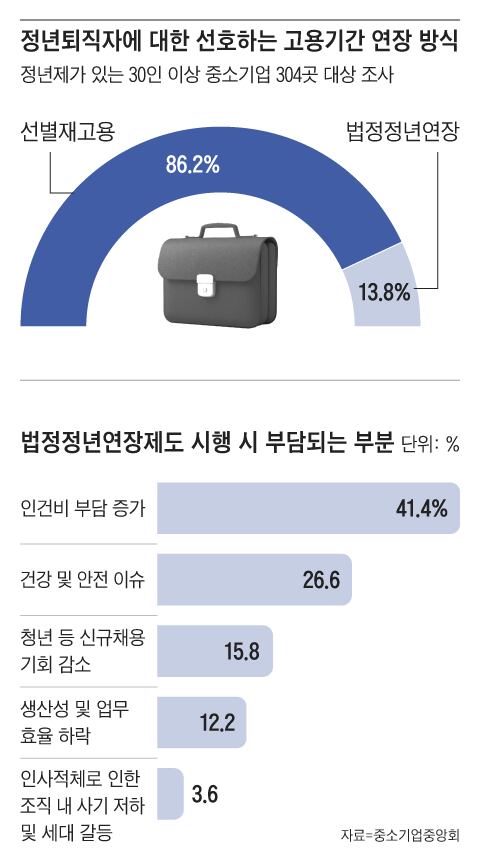
The Korea Federation of SMEs released the findings of its "Opinion Survey on Employment Extension Among Small and Medium-Sized Enterprises" on the 19th. The survey was conducted among SMEs with 30 or more employees that have a retirement system. According to the results, 86.2% of responding companies identified "selective re-employment" as the preferred approach for extending employment of retirees. Only 13.8% supported "statutory retirement age extension," a proposal often advocated by labor groups.
Selective re-employment refers to a system where employers decide on re-employment based on job performance, achievements, health status, and other factors. This allows for adjustments in employment duration and wages through new labor contracts.
Key Concerns for Extending the Statutory Retirement Age
According to SMEs, the most burdensome aspect of extending the statutory retirement age is increased labor costs, which accounted for 41.4% of concerns. This was followed by industrial safety and health issues at 26.6%, reduced opportunities for hiring youth and new employees at 15.8%, and declines in productivity and work efficiency at 12.2%.
While labor costs were the top concern across all industries, secondary concerns varied. Manufacturing and general service industries cited industrial safety and health issues, likely due to recent government emphasis on eradicating industrial accidents. In contrast, knowledge-based service industries highlighted reduced hiring opportunities for youth and new employees.
Current Practices in Re-employment
Two out of three SMEs (67.8%) already implement re-employment systems, such as rehiring retirees as contract workers. Among these, only 20.9% extended employment to all applicants, while the remainder decided based on job performance, achievements, and health status. Regarding wages for re-employed workers, 75.7% of companies maintained levels similar to pre-retirement, 23.3% reduced them, and 1.0% increased them.
Roles Most Likely to Require Extended Employment
Responses on which roles require extended employment varied by industry. In manufacturing, 93% cited production and technical roles, compared to 6% for general administrative positions. Knowledge-based service industries reported 48% for R&D roles and 32% for general administrative roles, while general service industries showed 46% for general administrative roles and 25% for R&D roles—distributed more evenly than in manufacturing.
Policies Needed to Support Employment of Older Workers
The policies most needed to promote employment of older workers, according to SMEs, were employment subsidies (89%) and tax support (85%). High responses were also recorded for social insurance support (74%) and safety and health support (67%).
Lee Myeong-ro, Head of the Human Resources Policy Division at the Korea Federation of SMEs, stated, "Flexible employment and wage systems, such as selective re-employment, are necessary to alleviate labor shortages in SMEs and address concerns about reduced youth hiring." He added, "As labor costs are the biggest burden for SMEs, substantial financial support through employment subsidies and tax incentives should be provided to reduce this cost pressure."


Comments
Post a Comment