Apartment Complex Prohibits Small Cars in Standard Parking Areas
A Controversial Notice Sparks Debate
A recent controversy has sparked heated discussions online after an apartment complex issued a notice prohibiting compact cars from parking in regular vehicle parking zones. The incident has drawn attention from residents and netizens alike, raising questions about fairness, practicality, and legal compliance.
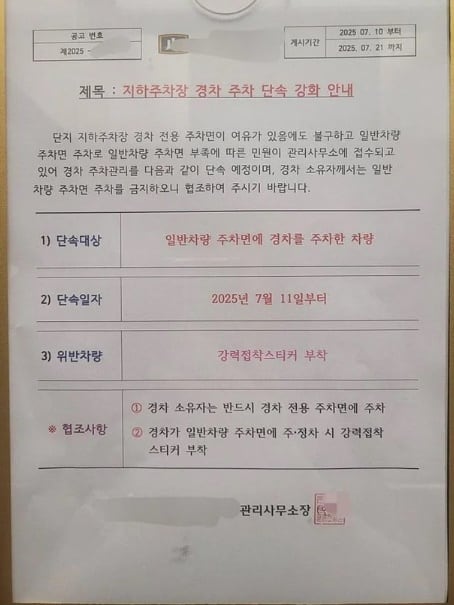
The notice, titled “Strengthened Enforcement of Compact Car Parking Regulations in Underground Parking Lot,” was distributed by the apartment’s management office. It highlighted that while there are sufficient dedicated parking spaces for compact cars in the underground parking lot, complaints have been received regarding the shortage of regular vehicle parking spaces due to compact cars occupying those spots.
The management office requested that compact car owners refrain from parking in regular vehicle parking spaces and cooperate with the new measures. According to the notice, all compact cars parked in regular vehicle parking spaces would be subject to enforcement starting the day after the notice was published. Violators would receive warnings via strong adhesive stickers.
Public Reaction and Concerns
The post quickly gained traction on online communities, with netizens expressing a range of opinions. Many were critical of the policy, questioning its logic and fairness. One comment read, “Aren’t compact cars not charged less for parking?” Another suggested, “If this is the case, just eliminate the dedicated parking zones for compact cars.”
Some users raised concerns about the practicality of the measure. One person asked, “If a compact car leaves and a regular vehicle parks there, how will you prove it?” Others pointed out that there are often empty compact car spots despite a lack of parking spaces, emphasizing the need for consideration and cooperation.
Another netizen noted, “Securing parking spaces should be the priority.” This sentiment reflects the broader concern among residents who feel that the policy may not address the root issue but instead creates unnecessary complications.
Legal and Ethical Considerations
Amid the debate, a netizen who identified as a current management office director shared their perspective. They stated, “There is absolutely no legal basis to prohibit compact cars from parking in regular parking spaces,” adding, “Even if such content exists in the management regulations, it cannot take precedence over the law.”
This statement highlights the potential legal implications of the policy. While the management office may have the authority to enforce certain rules within the complex, any regulation that contradicts local laws or public policies could face challenges. It also raises questions about the balance between property management rights and the rights of residents.
Broader Implications
The controversy has sparked a larger conversation about parking policies in residential complexes. Some argue that the solution lies in better management of existing parking spaces rather than imposing restrictions. Others suggest that the focus should be on improving infrastructure to accommodate more vehicles without creating conflicts.
In many urban areas, parking space shortages are a common issue, and solutions often require careful planning and community input. The situation at this apartment complex illustrates the challenges that arise when policies are implemented without considering the perspectives of all stakeholders.
Conclusion
The notice prohibiting compact cars from parking in regular vehicle parking zones has ignited a debate that goes beyond the immediate issue of parking. It touches on broader themes of fairness, legal compliance, and the need for inclusive decision-making in residential communities.
As the discussion continues, it remains to be seen whether the management office will revise its policy or find alternative solutions that address the concerns of all residents. For now, the incident serves as a reminder of the importance of transparency, communication, and legal awareness in managing shared spaces.


Comments
Post a Comment