Brain Changes Rapidly at 9, 32, 66, 83: Study Reveals Key Ages
The Human Brain: A Journey Through Four Major Transformations
A groundbreaking study has revealed that the human brain does not undergo change at a constant rate. Instead, it experiences four distinct periods of rapid transformation throughout life. These transformations occur at key ages—9, 32, 66, and 83 years—where the brain restructures itself to support cognitive processes aligned with human development, growth, maturation, and aging.
The research was conducted by a team of neuroscientists from the University of Cambridge. Their findings were published in the journal Nature Communications on the 25th of the month.
Key Phases of Brain Development
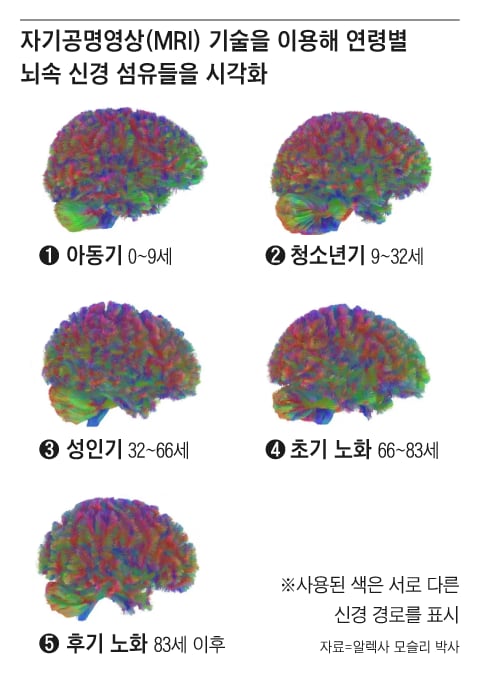
The researchers analyzed MRI diffusion scan data from the brains of 3,802 individuals aged between 0 and 90. Diffusion MRI tracks how water molecules move through brain tissue to visualize neural networks. Their analysis identified five major phases across the average human lifespan:
- Childhood (0–9 years)
- Adolescence (9–32 years)
- Adulthood (32–66 years)
- Early Aging (66–83 years)
- Late Aging (after 83 years)
Each phase is marked by significant changes in brain structure, with four turning points between them.
Childhood: The Foundation of Neural Networks
The first phase, childhood, involves network consolidation. During this period, synapses—the connections transmitting information between neurons—are overproduced, with only the most active ones retained. The brain operates inefficiently, akin to a child wandering aimlessly in a park. Gray matter (information-processing centers) and white matter (information-transmitting pathways) grow rapidly, forming the brain’s initial structure and driving cognitive changes.
Adolescence: Cognitive Peaks and Mental Health Risks
From age 9 onward, the brain enters the adolescence phase, which persists until the early 30s. The researchers noted that cognitive abilities peak by this stage. White matter continues to grow, and communication networks become more refined. This phase also carries the highest risk of initial mental health disorders. Previously thought to span only the teens and 20s, the study shows that adolescence extends into the early 30s.
Adulthood: Stability and Gradual Decline
The adult brain emerges around age 32, though this varies individually between 29 and 35. It then enters a stable period lasting approximately 30 years. While structural changes slow, efficiency gains gradually decline, and intelligence and personality reach a stable plateau. Dr. Alexa Moesley stated, “Around age 32, the brain undergoes its most directional changes, marking the largest structural turning point in life.” She added to the BBC, “This does not mean the brain stops changing but signals a shift to a new era of transformation.”
Early Aging: Gradual Rewiring and Increased Risks
After age 66, the brain enters early aging. Though no abrupt structural changes occur, gradual rewiring takes place. White matter connectivity declines, and brain networks shrink, shifting from global to localized operation. This phase sees increased risks of dementia and hypertension.
Late Aging: Localized Function and Global Connectivity Loss
The final turning point occurs around age 83. Global connectivity diminishes, and local connectivity becomes critical. The researchers observed a shift from global to localized brain function during this period.
Implications for Mental Health and Neurological Disorders
Dr. Duncan Astle remarked, “Just as life has phases, the brain experiences distinct eras. Neural development, mental health, and neurological disorders are closely tied to brain wiring, which influences behaviors like attention, language, and memory.”
The Cambridge team emphasized that while the brain continues to adapt to new knowledge and experiences, these changes are not linear but occur through key transitions. This understanding helps explain why risks of mental health disorders and dementia vary across life stages. They noted that while individual differences exist, the turning points were strikingly evident in the data.


Comments
Post a Comment