Capital Region Apartment Rates Drop 75 Percent
Declining Subscription Rates in Capital Region Apartments
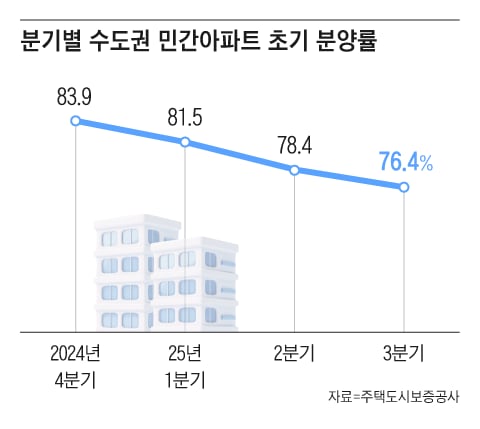
The initial subscription rate for apartments in the capital region during the third quarter of this year recorded 76.4%, marking a continuous decline for three consecutive quarters. This trend reflects a growing hesitation among potential buyers, influenced by various economic and regulatory factors.
According to statistics from the Korea Housing & Urban Guarantee Corporation (HUG) on the 12th, the initial subscription rate for private apartments in the capital region, which stood at 83.9% in the fourth quarter of last year, has continued to decline this year. The rates for the first, second, and third quarters were 81.5%, 78.4%, and 76.4% respectively. The initial subscription rate refers to the average subscription rate between three to six months after the start of sales. This decline is attributed to the impact of strengthened real estate regulations by the government, which have led actual demand-driven buyers to adopt a wait-and-see approach, affecting the subscription market.
Regional Disparities in Subscription Rates
Regional differences were pronounced. While Seoul’s initial subscription rate in the third quarter remained high at 96.7%, Gyeonggi Province recorded a mere 67.4%. The national average rose by 11.6 percentage points to 75.7% compared to the previous quarter, but the five major metropolitan cities and Sejong City fell by 7.6 percentage points to 50.3%.
The decline in initial subscription rates has also led to an increase in unsold housing units. According to the Ministry of Land, Infrastructure and Transport, as of the end of September, the number of unsold housing units nationwide stood at 66,762, a 0.2% increase from the previous month. Regionally, non-capital areas saw a 1.1% decrease to 51,411 units, while the capital region increased by 4.9% to 15,351 units.
Market Trends and Outlook
However, the subscription market shows no signs of recovery. The ‘November Housing Supply Outlook Index’ announced by the Korea Housing Institute on the 6th stood at 72.1, a drop of 19.4 points from the previous month. The capital region fell by 26.9 points, while non-capital regions decreased by 17.7 points.
This downward trend indicates that the real estate market is facing significant challenges. The combination of strict regulations and cautious buyer behavior has created a stagnant environment, with little optimism about a near-term rebound. Analysts suggest that the situation may persist unless there are substantial policy changes or economic improvements that can stimulate demand.
Key Factors Contributing to the Decline
- Government Regulations: Strengthened real estate regulations have made it more difficult for buyers to enter the market, leading to a slowdown in subscriptions.
- Economic Uncertainty: Buyers are adopting a wait-and-see approach due to concerns about economic stability and future prospects.
- Regional Imbalances: The disparity between the capital region and other areas highlights the uneven impact of these trends across different parts of the country.
- Inventory Build-Up: The rise in unsold housing units suggests that supply is outpacing demand, further pressuring the market.
Future Implications
The current state of the housing market raises questions about its long-term health. With subscription rates continuing to fall and inventory levels rising, the real estate sector may need to adapt to new conditions. Developers and policymakers will likely need to explore strategies to stimulate demand and address the underlying issues causing the decline.
As the market continues to evolve, it will be crucial to monitor developments closely. The coming months could provide more clarity on whether the current trends are temporary or indicative of a broader shift in the real estate landscape.


Comments
Post a Comment