Exclusive: Fivefold Online Lecture Surge Fuels AI Cheating Trend

Rise in Online Lectures and Challenges of Academic Integrity
Following the global impact of the COVID-19 pandemic, online education has become a significant part of academic life, especially at major universities in Seoul. As a result, there have been growing concerns about the rise in academic dishonesty, particularly with the use of artificial intelligence (AI) to assist in cheating. Institutions such as Seoul National University, Yonsei University, and Korea University have reported multiple instances of AI-assisted misconduct, leading to criticism that non-face-to-face lectures are contributing to this issue.
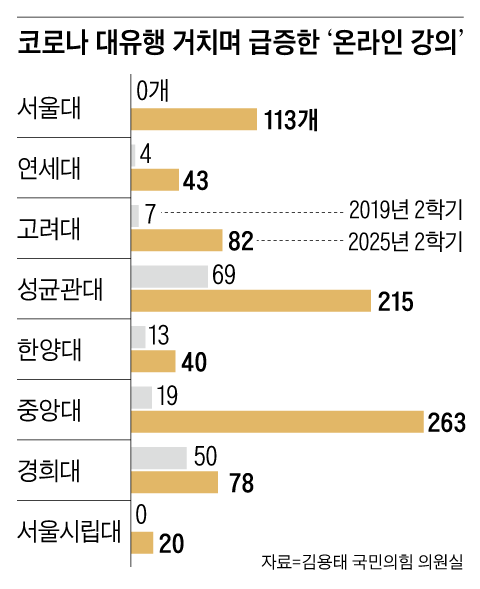
According to data from eight universities in Seoul, including Seoul National University, Yonsei University, Korea University, and others, the number of online lectures has seen a dramatic increase. Before the pandemic, in the second semester of 2019, these institutions offered only 162 online courses. By the second semester of 2025, this number had risen to 854, representing more than a fivefold increase over six years. For example, Seoul National University and the University of Seoul had no online lectures in 2019, but now they offer 113 and 20 respectively. Chung-Ang University experienced a 14-fold increase in online courses during the same period, while Yonsei and Korea Universities saw more than tenfold growth.
A university source noted that students who experienced the necessity of non-face-to-face lectures during the pandemic have increasingly requested online classes that reduce attendance burdens. This shift has led to a new normal in education, where online learning is not just a temporary solution but a long-term option.
The Challenge of Supervising Large-Scale Online Exams
As online lectures grow in scale, the challenge of maintaining academic integrity becomes more complex. Before the pandemic, large-scale online lectures with over 100 students were almost nonexistent. Now, around 20 to 30 such courses exist in major Seoul universities. In the past, cheating was typically limited to opening books or consulting with peers during exams. However, recent trends show an increase in the use of generative AI to provide immediate answers to exam questions.
Universities have attempted to monitor exams by requiring students to connect their laptop cameras. However, it is challenging for professors and teaching assistants to effectively prevent cheating when monitoring only the screen. For instance, during a midterm exam at Yonsei University, approximately 50 students were caught cheating in a class with 600 participants. Despite instructions for students to record and submit videos showing their computer screen, hands, and face, several cases involved students adjusting camera angles to obscure their screens or looking away from the screen. There were also signs of students searching for answers via the internet or AI during the exam.
Similarly, at Korea University, some students in a liberal arts course with 1,400 enrollments were caught sharing questions and answers through KakaoTalk. These incidents highlight the difficulties of maintaining academic honesty in large online classes.
Calls for Better Evaluation Methods
In response to these challenges, there are growing discussions within the academic community about the need for better evaluation methods suited for the AI era. Honorary Professor Park Nam-ki from Gwangju National University of Education pointed out that schools have been slow to adapt. He suggested that institutions should allocate space and manpower at the university level, such as dividing exam periods by subject, to ensure in-person exams.
Korea University recently informed all professors of the "principle of in-person exams." A university official stated that ahead of final exams, a notice was sent requesting in-person exams. If non-face-to-face exams are unavoidable, separate guidelines will be established. Similarly, Seoul National University and Yonsei University have announced measures to prevent academic dishonesty, indicating a move toward more secure and reliable assessment methods.


Comments
Post a Comment