Kenyan Papers Highlight Gachagua and Wanga Amid NCIC Hate Speech Probe
Key Developments in Kenyan Politics and Governance
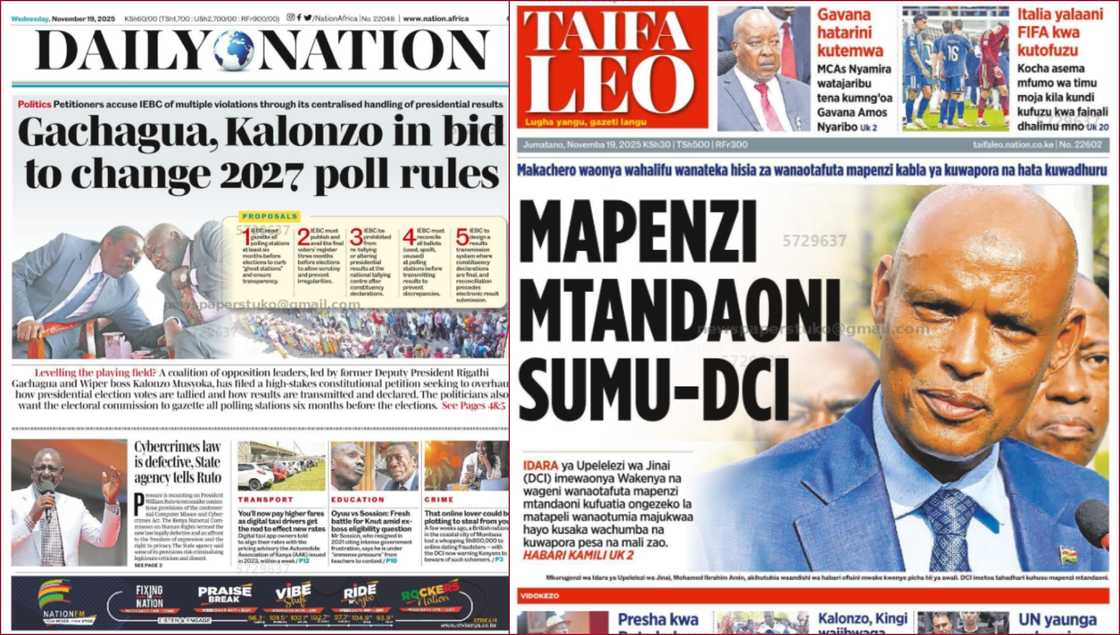
On Wednesday, November 19, the newspapers highlighted a wide range of topics, with the political landscape for 2027 taking center stage across various publications. Alongside this, several critical issues were brought to light, including an ongoing investigation into alleged hate speech by prominent political figures.
The Star: Investigation into Alleged Hate Speech
The Star reported on the ongoing probe into alleged hate speech by high-profile individuals, including former Deputy President Rigathi Gachagua. Gachagua, along with four governors and ten Members of Parliament (MPs), is under scrutiny for inciting hatred and spreading inflammatory rhetoric.
The National Cohesion and Integration Commission (NCIC) disclosed that the investigations are at different stages. Despite its reputation as a weak institution, the NCIC expressed frustration over the refusal of some suspects, including Gachagua, to appear for questioning. In a report submitted to the Senate, the commission confirmed it is investigating several governors, including Mutahi Kahiga from Nyeri, Gladys Wanga from Homa Bay, Jeremiah Lomorukai from Turkana, and Isaac Mutuma from Meru.
Among the MPs under investigation are Mpuru Aburi from Tigania West, Farah Maalim from Dadaab, Amos Mwago from Starehe, Dan Wanyama from Webuye West, and Nelson Koech from Belgut. Others include Phelix Odiwuor from Lang’ata, William Kamket from Tiaty, Said Hiribae from Galole, Yakub Kuno from Bura, Amina Dika from Tana River Woman Representative, and Fatuma Jehow from Wajir Woman Representative.
During a session before the Senate Committee on National Cohesion, Equal Opportunities, and Regional Integration, NCIC Chief Executive Officer Daniel Mutegi stated that 28 leaders had been summoned, with some responding while others ignored the summons. He specifically mentioned that the former Deputy President and MPs Koech, Odiwuor, Wanyama, and Jehow did not appear to explain their actions.
Mutegi noted that several legislators, including Aburi, Kamket, Hiribae, Maalim, Kuno, Dika, and Mwago, complied with the summons and were interrogated regarding their inflammatory remarks. This provided them with an opportunity to clarify their statements.
He further informed the committee, chaired by Marsabit Senator Mohammed Chute, that the NCIC faces significant challenges in addressing hate speech cases, largely due to insufficient funding that hampers the investigative process. Mutegi emphasized that hate speech, ethnic contempt, and inflammatory language from influential politicians remain key drivers of conflict and violence, urging senators to support increased funding for the commission.
"We would like to inform the Senate that the commission lacks political goodwill, especially regarding amendments to the NCIC Act," he said. "Since 2014, we have attempted to amend the Act, but the Bill has never progressed beyond the second reading in the National Assembly."
Nominated Senator Catherine Mumma raised concerns about the rising cases of hate speech and ethnic profiling, warning that inaction by state agencies could lead the country toward violence as elections approach. She urged the National Cohesion and Integration Commission and the National Gender and Equality Commission to take decisive action to prevent a repeat of the 2007 crisis, when the failure of relevant agencies led to widespread violence.
Meanwhile, the Kenya National Commission on Human Rights (KNCHR) criticized the Office of the Director of Public Prosecutions (ODPP) for withdrawing several high-profile hate speech and incitement cases. This move has sparked further debate on the effectiveness of legal mechanisms in addressing such serious offenses.


Comments
Post a Comment