Korean Consumer Stocks Rise Amid Japan Tension Fears
Market Trends and Consumer Goods Resilience
In a market characterized by bearish sentiment, the KOSPI has experienced a decline of over 6% this month. Despite this downturn, consumer goods-related indices and stocks have shown an upward trend. This contrast is notable, as large tech stocks—previously buoyed by concerns over an artificial intelligence (AI) "bubble"—have seen their momentum stall. Analysts suggest that expectations surrounding potential benefits for Korean consumer goods companies from the ongoing conflict between China and Japan are influencing the current market dynamics.
From June to October this year, the KOSPI saw a significant rally of 52.3%, primarily driven by the semiconductor sector. However, during this period, the KRX Essential Consumer Goods Index and the KRX Cyclical Consumer Goods Index only managed to rise by 8.5% and 4.6%, respectively. This indicates that the consumer goods sector was largely excluded from the broader market rally.
Expectations for 'Collateral Benefits' Amid Sino-Japanese Conflict
The market sentiment shifted dramatically in November. As of the 24th, the KOSPI had fallen 6.4%, and the KOSDAQ Index dropped 4.9%. In contrast, the KRX Cyclical Consumer Goods Index rose 4.5%, while the KRX Essential Consumer Goods Index increased by 2%. The KRX300 Essential Consumer Goods Index also gained 2.1% during the same period, highlighting a clear divergence.
The catalyst for this shift was the diplomatic conflict between China and Japan. On the 7th, Japanese Prime Minister Sanae Takaichi made remarks suggesting that Japan could exercise the right to collective self-defense in the event of a Taiwan contingency. This statement rapidly worsened bilateral relations. The Chinese government responded by demanding a retraction of the remarks and escalating pressure by urging its citizens to avoid traveling to Japan and suspending imports of Japanese seafood. On the 18th, Chinese media outlet Pengpai reported that major Chinese travel agencies had canceled group tour reservations to Japan.
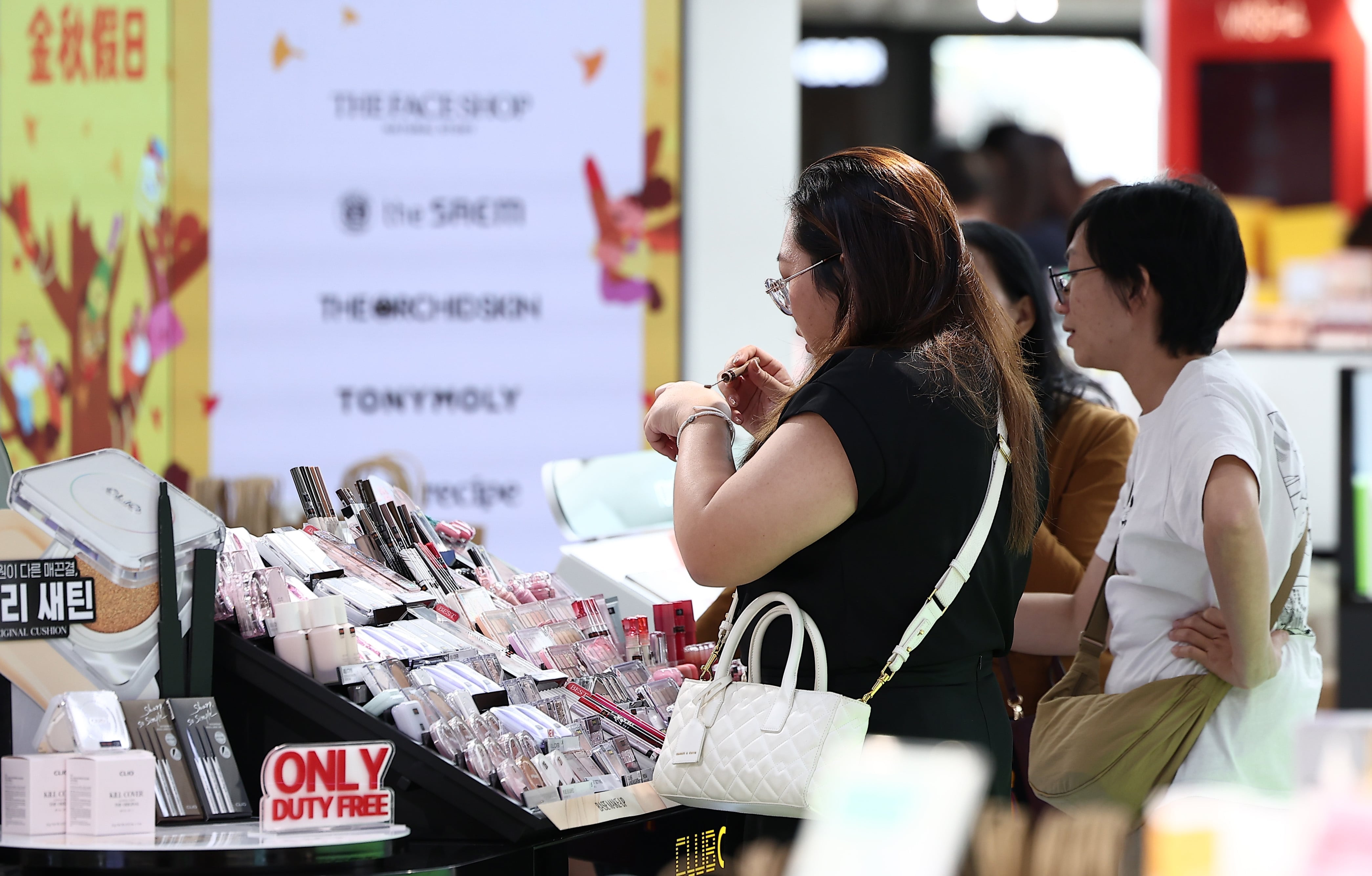
This situation created expectations that if Chinese demand for travel to Japan declines, Korea’s tourism and consumer sectors could benefit. Indeed, while foreigners net-sold 13.0947 trillion Korean won worth of KOSPI stocks and 438.1 billion Korean won in KOSDAQ stocks as of the 24th, they actively bought consumer goods stocks. Notable purchases included Nongshim (67.5 billion won), Amorepacific (64.7 billion won), Samyang Foods (47.6 billion won), and Lotte Tourism Development (41.0 billion won). Institutions also focused on the sector, net-buying Samyang Foods (154.2 billion won), Amorepacific (96.4 billion won), Shinsegae (73.6 billion won), and Hyundai Department Store (50.8 billion won).
Park Ki-hoon, a researcher at Korea Investment & Securities, noted, “Funds are flowing into related consumer stocks in the short term as Sino-Japanese tensions escalate.” He added, “Considering Korea’s rising status in culture and arts, Korea could emerge as a meaningful alternative destination to Japan for travelers.” Park emphasized the importance of selecting structurally beneficial sectors rather than approaching this as a short-term theme.
'Likelihood of Rebound Concentrated in First Half'
In addition to the collateral benefits from the bilateral conflict, expectations for domestic recovery next year are also cited as a background for the rising consumer goods stocks. After a year of sluggish domestic sentiment, a recovery is expected to begin in earnest in 2026.
According to DB Securities, the combined net profit of the distribution industry next year is projected to increase by 83.1% compared to this year. DB Securities cited reasons including the wealth effect from simultaneous rises in real estate and stock markets, slowing interest and inflation rates, and the potential for increased disposable income due to improved export conditions.
Heo Je-na, a researcher at DB Securities, stated, “The department store sector shifted to sales growth from the third quarter of this year, and profitability is expected to improve in 2026, when the clothing replacement cycle arrives after three years.” She added, “Duty-free shops and convenience stores are showing improved fundamentals through cost reductions and store rationalization amid long-term domestic sluggishness post-COVID-19.”
Prospects also emerged that overseas expansion of ‘K-Consumer Goods’ (Korean consumer goods) would drive stock gains for related companies. Ha Hee-ji, a researcher at Hyundai Motor Securities, said, “The largest value premium for food and beverage companies is expected to come from overseas growth.” She added, “For example, volume growth overseas for ramen companies can be anticipated.”
Domestic cosmetics are also expected to see over 10% export growth next year as their global recognition continues to rise. Ha Hee-ji, the Hyundai Motor Securities researcher, said, “Global export growth in the cosmetics sector is expected to continue in 2026,” adding, “Cosmetics export growth will accelerate not only in the U.S. but also in Europe and the Middle East.”


Comments
Post a Comment