Middle-Market Firms Opt for Rehiring Over Delaying Retirement
Survey Reveals Preferences of Middle-Market Enterprises on Elderly Employment
Recent discussions about extending the retirement age to 65 have sparked significant debate, particularly within the National Assembly. A survey released on the 10th highlights the preferences of small and medium-sized enterprises (SMEs) regarding the continued employment of elderly workers. The findings indicate that SMEs are more inclined towards "re-employment after retirement" than "retirement age extension."
According to the results of the "Survey on Continued Employment Status of Middle-Market Enterprises," conducted by the Federation of Middle Market Enterprises of Korea, 62.1% of middle-market enterprises prefer re-employment after retirement as a method for continuing to employ elderly workers. This is significantly higher than the 33.1% who favor retirement age extension and the 4.7% who support abolishing the retirement age altogether. The federation noted that this trend remains consistent across different company characteristics such as industry, sales scale, and number of workers.
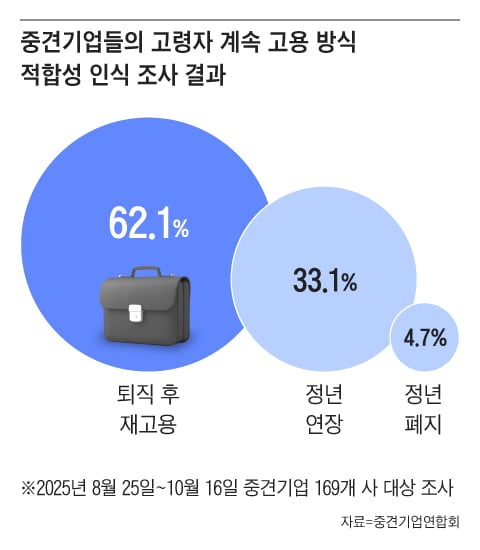
The survey, which ran from August 25 of last year to the 16th of last month, targeted 169 middle-market enterprises. The middle-market enterprise sector expressed major concerns about increased labor cost burdens (64.5%) and reduced capacity for hiring new youth (59.7%) if the current legal retirement age of 60 years is uniformly extended. Responses indicating worsening personnel backlogs within organizations reached 41.4%.
In terms of labor costs, 44% of middle-market enterprises reported that labor costs would increase by 20% or more. Approximately 45% predicted an increase of 10–20%, while only 11% stated there would be no change.
It was found that 52.6%, exceeding half, of middle-market enterprises continue to employ workers who have already surpassed the legal retirement age. However, similar to their preferences, 69.6% were choosing the "re-employment after retirement" method.
Reasons for Re-Employment
The primary reason middle-market enterprises re-employ elderly workers was to utilize their expertise and know-how (84.2%). This response rate was significantly higher compared to "resolving labor shortages due to difficulties in new hiring" (24.7%) and "fulfilling corporate social responsibility" (20.2%).
The wages of re-employed elderly workers were typically 80–90% of the level at the time of retirement. Only 31% of middle-market enterprises paid wages equivalent to 100% or more compared to the retirement age point.
Policy Recommendations
Middle-market enterprises emphasized the need for expanded tax benefits and direct support for labor costs to activate continued employment of the elderly. Policy supports such as enhancing employment flexibility and alleviating social insurance premium burdens were also identified as urgently needed.
Lee Ho-jun, Senior Vice Chairman of the Federation of Middle Market Enterprises of Korea, stated, "Uniform retirement age extensions disconnected from on-site demands may instead undermine corporate fundamentals due to increased labor cost burdens, among other issues." He added, "To achieve both enhanced corporate competitiveness and stable employment for the elderly, practical alternatives that broadly encompass social policies—such as expanding job transition and re-employment education and strengthening elderly welfare—should be sought rather than definitive retirement age extensions."


Comments
Post a Comment