NVIDIA's 260,000 GPUs Power Five AI Data Centers
NVIDIA's AI Alliance and the Supply of 260,000 High-Performance GPUs
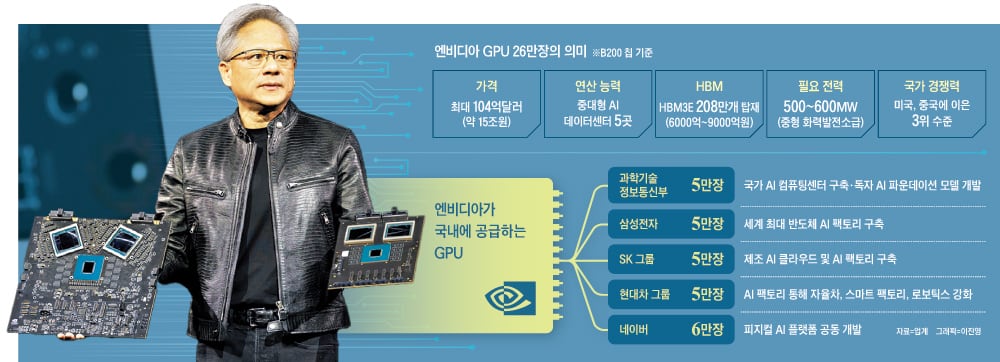
NVIDIA has formed a significant partnership with South Korea by agreeing to supply 260,000 high-performance GPUs to the government and major companies. This initiative involves the South Korean government, Samsung, SK, and Hyundai Motor each receiving 50,000 units, while Naver will obtain 60,000. The total number of GPUs surpasses the current 45,000 high-performance GPUs in the country and will be prioritized for use until 2030. This move is expected to greatly enhance the domestic AI ecosystem, which has faced challenges due to infrastructure shortages.
What GPUs Are Being Supplied?
NVIDIA announced that it will supply an infrastructure based on 260,000 Blackwell GPUs. Blackwell is the latest architecture introduced by NVIDIA in 2024. The B200 is an AI accelerator that combines a Blackwell GPU with eight fifth-generation high-bandwidth memory (HBM3E) units. Compared to the previous H100 model, the B200 offers three times the AI training performance and 15 times the inference performance.
The product name of the AI accelerator may vary depending on the form of supply. According to industry sources, NVIDIA GPUs are expected to be supplied to South Korea in the form of the GB200 and the 'RTX 6000' series for professional PCs. The GB200 is an AI superchip that combines two B200 AI accelerators with a NVIDIA central processing unit (CPU) called Grace. These systems are often supplied as rack (shelf) unit server systems with 36 GB200s connected. It remains unclear whether they will be supplied to South Korea in rack units. However, if NVIDIA releases new product lines based on its next-generation GPU designs, such as Rubin and Feynman, the types of GPUs supplied could change.
What Is the Scale?
Numerically, the 260,000 GPUs supplied to South Korea exceed those provided to the UK (120,000) and the EU (100,000). Typically, a medium to large AI data center is equipped with 50,000 GPUs, meaning 260,000 units would be enough to build five such centers with surplus. Given that the B200 is estimated to cost between $30,000 and $40,000, the total supply value of 260,000 units reaches approximately $10.4 billion (around 15 trillion won).
With the additional 260,000 GPUs, South Korea's stock of advanced GPUs will exceed 300,000 units. Ha Jung-woo, presidential office AI Future Planning Chief, stated, "NVIDIA CEO Jensen Huang mentioned that the U.S. has around 20 million GPUs, followed by China," adding, "While the U.S. and China are far ahead, in terms of secured volume, South Korea ranks third."
The 260,000 Blackwell GPUs will be equipped with 2.08 million HBM3E units. As these GPUs will be utilized in South Korea's AI ecosystem, the entire volume is expected to be supplied by Samsung Electronics and SK Hynix. The price of an 8-layer HBM3E is estimated at $200–$300 per unit, meaning the total cost of HBM for 260,000 GPUs could reach 600 billion to 900 billion won. Jensen Huang CEO stated, "Both Samsung Electronics and SK Hynix, with their outstanding technological capabilities, are necessary," adding, "We will become long-term partners to jointly develop HBM4, HBM5, and HBM97."
Applications and Remaining Challenges
NVIDIA GPUs will be utilized to integrate AI into South Korea's core industries. Samsung and SK will introduce AI across their semiconductor production processes, while Hyundai Motor will apply GPUs to vehicle AI and autonomous driving. This will establish 'AI factories' where AI is incorporated into all manufacturing processes. Kim Jeong-ho, a professor at KAIST, stated, "Combining AI with industries where South Korea has strengths, such as semiconductors, manufacturing, and automobiles, is the formula for success," adding, "I believe South Korea's path forward is to enhance the competitiveness of its established industries by leveraging the secured AI infrastructure."
The power required to operate the GPUs remains a challenge. A rack (shelf) unit server system (NVL72) connecting 36 GB200s consumes 132 kW (kilowatts) of power, which scales to approximately 480 MW (megawatts) for 260,000 units. Including cooling and auxiliary facilities, power consumption is projected to reach 500–600 MW—equivalent to a medium-sized thermal power plant or half a large nuclear reactor. Lee Jong-hwan, a professor at Sangmyung University's Department of System Semiconductor Engineering, stated, "Building power infrastructure is absolutely urgent," adding, "Even with a large-scale GPU supply, power shortages could act as a bottleneck."


Comments
Post a Comment