Office Market Resurgence vs Knowledge Hubs' Decline
Recovery in Seoul and Bundang Office Markets
The office markets in Seoul and Bundang are showing signs of recovery, breaking free from a prolonged period of price stagnation. This positive trend is particularly notable as it contrasts with the ongoing challenges faced by knowledge industry centers, which continue to struggle with oversupply and weak demand.
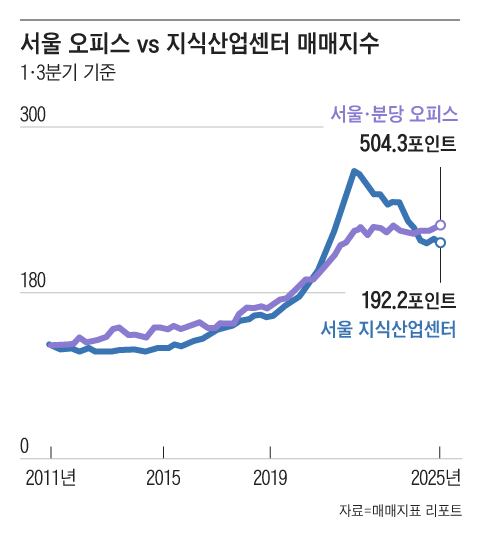
According to the "Third Quarter 2025 Office and Knowledge Industry Center Sales Index Report" released by Al Square Research Center, a commercial real estate service company, the Seoul-Bundang office sales index reached 504.3 points in the third quarter, marking a 1.5% increase from the previous quarter. This represents an approximately fivefold rise compared to the first quarter of 2001, when the index stood at 100 points. The data suggests that the market has entered a recovery phase, moving away from the price stagnation that followed the peak in 2022.
Cumulative office transaction amounts from the beginning of this year to the third quarter totaled 15.1 trillion won, showing a clear rebound compared to the 9.6 trillion won recorded in 2023. With two consecutive years of growth following last year, transactions have now recovered to pre-pandemic levels. This indicates a strong return of buyer confidence and activity in the office market.
Challenges in Knowledge Industry Centers
In contrast, the knowledge industry center sales index for the third quarter of this year was 192.2 points, a decrease of 1.5% from the previous quarter and 6.8% year-on-year. The index has not shown any significant rebound since it fell approximately 25% from its peak in the second quarter of 2022. Al Square Research Center analyzed that the overheated atmosphere in the market, driven by small-scale investments during the low-interest rate and housing regulation environment from 2020 to 2022, is now dissipating.
The analysis also pointed out that investment demand has exceeded actual demand, leading to continued price volatility. This imbalance highlights the challenges faced by knowledge industry centers, which remain in a state of oversupply and are struggling to attract consistent buyer interest.
Divergent Market Trends
Al Square also noted a clear divergence in the correlation between the office and knowledge industry center markets and interest rates. While the office market reacts quickly to falling interest rates, showing an upward trend, knowledge industry centers are more influenced by investor sentiment and regulatory environments than by interest rates. As a result, their recovery pace is inevitably slower.
This divergence underscores the different dynamics at play in each segment of the real estate market. The office market's responsiveness to interest rate changes reflects a more direct link between financial conditions and property valuations. Meanwhile, knowledge industry centers face a more complex set of factors, including shifting investor preferences and evolving regulatory frameworks.
Outlook for the Future
As expectations for interest rate cuts continue to rise, the office market is likely to see further activity and potential price increases. However, knowledge industry centers may require more time to stabilize and regain momentum. The gap between these two asset classes is expected to widen further unless there are significant changes in demand or regulatory policies.
For investors and stakeholders, understanding these trends is crucial in making informed decisions about property investments and market strategies. The contrasting performance of the office and knowledge industry center markets highlights the importance of monitoring economic indicators and adapting to changing market conditions.


Comments
Post a Comment