PM Kim Calls for Japan's Role in Government Dialogue
Strengthening Korea-Japan Relations Through Civilian Cooperation
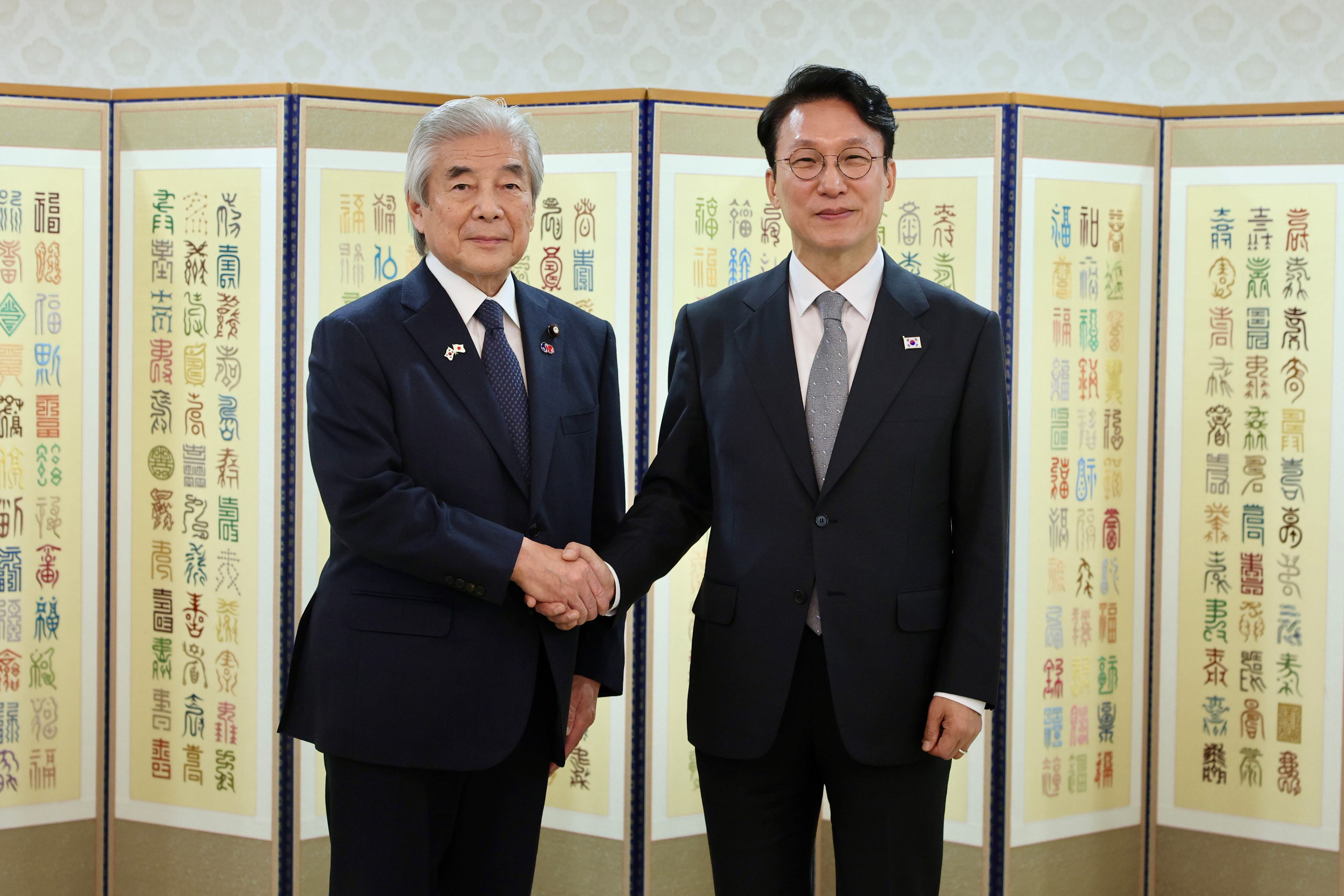
Prime Minister Kim Min-seok met with the Japanese delegation of the Korea-Japan/Japan-Korea Cooperation Committee on the 24th, highlighting the importance of expanding next-generation exchanges between the two nations. During the meeting, the Prime Minister also requested Nakasone Hirofumi, chairman and close aide to Japanese Prime Minister Sanae Takaichi, to help facilitate communication between the governments of South Korea and Japan.
The Japanese delegation, which visited South Korea on the 22nd to attend the 58th joint general meeting of the Korea-Japan/Japan-Korea Cooperation Committee held in Jeju, was hosted by Prime Minister Kim at the Government Complex Seoul on the morning of the 24th. The delegation included several key figures, such as Nakasone Hirofumi, acting chairman and former foreign minister; Nagashima Akihisa, vice chairman and former chief national security advisor; Yamaguchi Tsuyoshi, standing director and former environment minister; Hori Iwao, standing director and former vice foreign minister; and Matsukawa Rui and Hirayama Sachiko, both standing directors. Notably, Nakasone Hirofumi served as a campaign manager for Prime Minister Takaichi during the Liberal Democratic Party leadership election last month.
Building on Past Successes
Prime Minister Kim began the meeting by expressing his appreciation for the successful hosting of the joint general meeting. He noted that this year's event, held in Jeju for the first time, signifies that cooperation between the two countries is expanding beyond the capitals and into regional areas.
He also praised the multiple summit-level diplomatic efforts since the launch of the new government, which have led to agreements on future-oriented cooperation between South Korea and Japan. "I highly appreciate that through these efforts, the two countries have aligned on the importance of maintaining strong relations," he said.
Emphasizing Civilian and Political Exchanges
In addition to government-level cooperation, Prime Minister Kim emphasized the significance of exchanges at the political and civilian levels. He urged the Korea-Japan/Japan-Korea Cooperation Committee to continue pooling its wisdom and efforts to strengthen bilateral relations.
Addressing Nakasone Hirofumi directly, the Prime Minister expressed hope that he would play a key role in facilitating smooth communication and cooperation between the South Korean government and the Takaichi administration.
Nakasone Hirofumi responded positively, noting his satisfaction with the congratulatory remarks from both leaders at the meeting and the fruitful discussions held for the development of bilateral relations. He highlighted the need to strengthen Korea-Japan and Korea-U.S.-Japan cooperation to address common challenges such as geopolitical crises and changes in the international economic structure.
Legacy and Future Contributions
Nakasone Hirofumi also reflected on his father’s legacy, former Prime Minister Nakasone Yasuhiro, who was known for his pro-Korea stance and emphasis on the importance of Korea-Japan relations. As chairman of the Japan-Korea Cooperation Committee, he has worked to maintain communication channels even during difficult times in bilateral relations. He pledged to continue contributing to the development of friendly cooperation between the two countries.
Focusing on Youth and Cultural Exchanges
Prime Minister Kim also spoke about the importance of economic and cultural cooperation within the Asia-Pacific region, particularly through initiatives like APEC in Gyeongju. He emphasized that exchanges between the youth generations will be crucial for continuing these efforts into the next generation. "We hope to cooperate with Japan to expand next-generation exchanges," he added.
According to the Office of the Prime Minister, the Japanese participants expressed agreement with this vision, stating that they particularly look forward to deepening mutual understanding between the next generations of the two countries through exchanges among children and cultural exchanges, including K-pop.


Comments
Post a Comment