Producer inflation hits 1.4% in October, four-year low
Overview of Producer Price Inflation
Producer price inflation (PPI) saw a significant decline in October 2025, dropping to 1.4 percent—the lowest rate recorded in four years. This marks a further reduction from the 3.2 percent recorded in September and continues the disinflationary trend observed across major industrial sectors throughout the year.
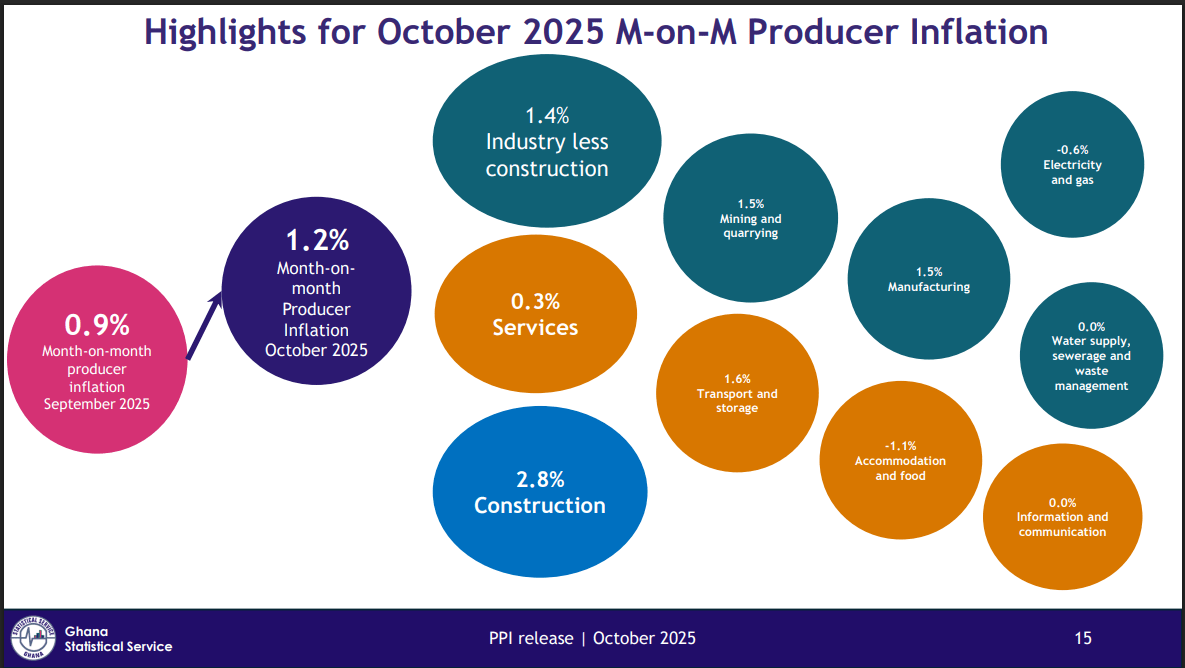
The PPI measures the average change over time in the prices that domestic producers receive for their goods and services. Despite the overall slowdown in annual inflation, month-on-month producer prices increased by 1.2 percent between September and October, compared to a 0.9 percent increase in the previous month. This suggests that while long-term inflation has decreased significantly, some industries still face short-term price pressures.
Sectoral Performance
The headline decline in PPI was primarily driven by steep disinflation in the mining and quarrying sector, which holds the largest weight in the PPI basket at 43.7 percent. Inflation in this sector dropped to 0.7 percent in October, down from 5 percent in September, reflecting a decrease of 4.3 percentage points. The slowdown was widespread, indicating easing cost pressures across key mining activities.
Electricity and gas also contributed to the downward trend, with their inflation rate falling sharply from 9 percent in September to 5 percent in October. Energy inflation has been volatile throughout the year, often influencing overall producer prices due to its critical role in industrial production.
Manufacturing, the second-largest component of the PPI with a 35 percent weight, saw a modest rise in inflation from 1.7 percent in September to 2.5 percent in October. Although this represents a slight increase, the sector continues to experience relatively subdued cost pressures compared to last year when double-digit factory-gate inflation was common.
Construction also experienced a substantial cooling in producer prices, with annual inflation dropping to 0.4 percent in October from 4.6 percent in September. Within the sector, civil engineering activities showed some upward pressure, while building construction continued to record negative inflation, indicating falling costs for materials in that sub-category.
The services sector remained generally weak, with marginal price movements across most subsectors. Accommodation and food service activities posted a year-on-year decline of 1.8 percent, while transport and storage remained in deep negative territory at -8.8 percent, pointing to ongoing disinflationary effects in logistics and mobility-related services.
Sub-sector Highlights
A closer look at the October data reveals considerable divergence across specific industries. In manufacturing, sectors such as food products, rubber and plastics, textiles, and fabricated metal products saw moderate price increases. Conversely, refined petroleum products, wood products, and basic metals recorded declines, highlighting uneven recovery across the industrial landscape.
In the services sector, air and water transport activities saw strong year-on-year growth, while warehousing, publishing, and select administrative services contracted. This reflects persistent weakness in certain parts of the service economy, particularly those sensitive to energy and logistics costs.
Mining support service activities showed some of the highest inflation rates within the broader mining category, even as extraction activities such as crude oil and natural gas recorded contractions. These contrasts underscore the mixed performance across Ghana’s industrial ecosystem.
Recommendations
Government Statistician Dr. Alhassan Iddrisu urged stakeholders to use the new cost environment to support economic resilience. He encouraged businesses to take advantage of lower input costs to improve production efficiency and strengthen competitiveness. Additionally, he advised the government to sustain reforms in energy, logistics, and manufacturing to lock in stability.
He further noted that households should monitor market prices closely, emphasizing that easing producer prices should, all things being equal, translate into relief at the retail level, especially in essential expenditure areas such as transport, food, and utilities.
With October’s figure representing the lowest producer inflation rate since 2021, analysts say the trend offers a positive signal for the broader economy. However, they caution that the uneven sectoral performance means the transmission of lower producer prices to consumers may vary across industries. Continued monitoring will therefore be essential in assessing the durability of the disinflation path in the coming months.


Comments
Post a Comment