Stablecoins Threatened by Terra-Style Depegging Crisis
The Collapse of Stablecoins and the Risks They Pose
The virtual currency market has experienced significant instability in recent times, with stablecoins—designed to maintain a stable value tied to fiat currencies—facing a series of depegging events. These incidents have resulted in substantial losses for investors, raising concerns about the reliability of these digital assets.
Stablecoins are marketed as maintaining a consistent value, such as "1 coin = 1 dollar." However, when their value deviates from this peg, it is referred to as depegging. This phenomenon has prompted calls for increased caution among investors. While some stablecoins, like Tether (USDT) and USDC (issued by Circle), have managed to maintain relatively stable values by holding significant portions of their reserves in cash or U.S. short-term Treasury bonds, others have faced severe challenges.
The problematic stablecoins are those that claim to maintain value through undisclosed algorithms or complex derivatives rather than liquid reserves. Many of these coins are similar to Terra, which caused widespread damage when its price collapsed in May 2022. These types of stablecoins are often referred to as "algorithmic coins" or "synthetic coins."
When faced with mass sell orders, these unstable coins temporarily lose value because they cannot redeem all coins. This leads to a vicious cycle where collapsing trust triggers more sell-offs, causing prices to plummet. This pattern is reminiscent of the Terra crisis.
The series of depegging incidents began in October last year after U.S. President Donald Trump announced plans to raise tariffs on China, leading to a general crash in coin values. At that time, the stablecoin "Ethere (USDe)" temporarily crashed to $0.65 on the global exchange "Binance." Ethere, a "synthetic stablecoin" that uses various derivatives as reserves, drew market criticism for having a "complex structure that obscured risks."
Although Ethere later recovered its value, in November—when virtual currency prices generally fell—stablecoins that failed to recover value began emerging one after another. xUSD, which had complex reserve management, saw its price plummet 70% to $0.30 per coin on the 4th after its issuer, "Stream Finance," disclosed a $93 million operational loss. Although it has since partially recovered, the coin's price remains at $0.68.

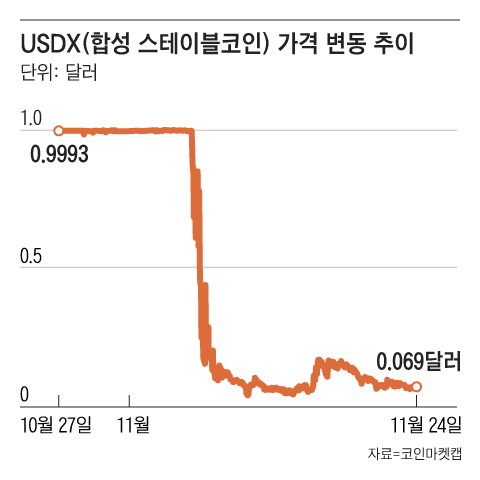
Another synthetic stablecoin, USDX, which once had a market capitalization of around $180 million, saw its value plummet on the 6th and is now trading at $0.07 per coin—effectively near "zero." Initial causes of the value drop include collateral management failures, but once selling began, a vicious cycle of uncontrollable price declines ensued. Additionally, deUSD, which had a market capitalization of around $160 million, recorded the fastest crash since Terra, collapsing from $1 to $0.02 within 48 hours on the 10th. The virtual currency media outlet CCN reported, "Billions of dollars are disappearing within hours."
The U.S. stablecoin regulation law enacted last July stipulates that issuers must hold liquid assets, such as dollars and short-term Treasury bonds, as reserves corresponding to the scale of their coins. However, the law's scope is limited to "payment stablecoins," leaving algorithmic and synthetic stablecoins unregulated. Payment stablecoins are used for real-life payments and remittances, whereas algorithmic and synthetic stablecoins are mostly used for investment within the coin ecosystem.
Although Tether and USDC, the world's top two stablecoins, have relatively solid reserves, experts warn that sudden large-scale redemptions could overwhelm their capacity, leading to depegging. Tether, in particular, is considered more vulnerable to redemption risks as 23% of its reserves are in non-liquid assets like Bitcoin, gold, and loan bonds. Indeed, during the March 2023 Silicon Valley bankruptcy incident, USDC's value fell to $0.87 per coin over approximately 48 hours before recovering after U.S. government intervention.
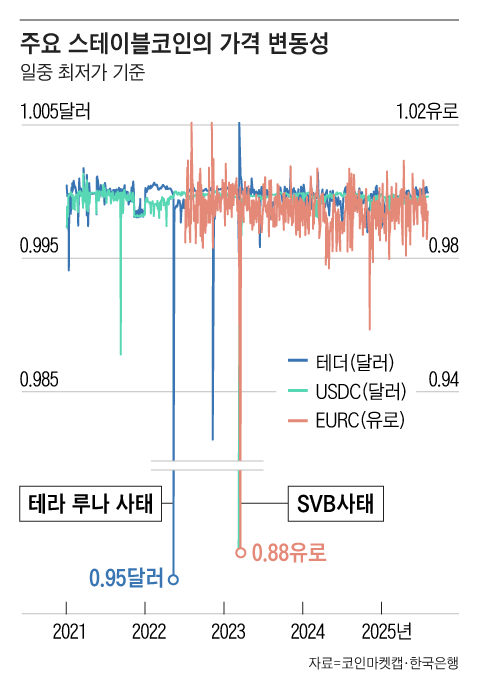
As South Korea pushes for stablecoin issuance through related legislation, the Bank of Korea stated in its stablecoin white paper last month: "Ensuring that issuers secure reserves equal to or exceeding 100% of issuance is a minimum requirement for maintaining stable value, but it is not a sufficient condition to guarantee value itself." It added, "Even if Korean won stablecoins secure 100% reserves, they are likely to experience higher volatility and more frequent depegging compared to dollar stablecoins."


Comments
Post a Comment