Top 10 Exporters Hit 40% Record Share
Record High Trade Concentration Ratio
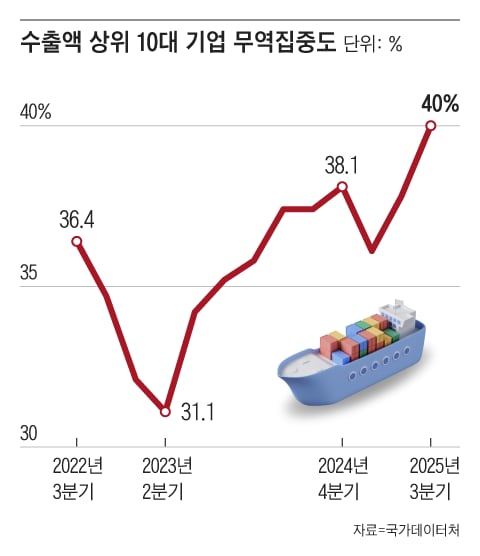
The trade concentration ratio of the top 10 exporters by export value in the third quarter of this year reached a record high of 40.0%. This indicates that exports are becoming increasingly concentrated among a small number of large corporations, driven by the semiconductor export boom that has significantly improved the performance of major companies.
According to the 2025 Third Quarter Trade Statistics by Enterprise Characteristics released by the Ministry of Data and Statistics on the 10th, the trade concentration ratio of the top 10 exporters by export value in the third quarter was 40.0%, up 2.6 percentage points from the same period last year (37.4%). This is the highest figure since the quarterly statistics by enterprise characteristics were first compiled in 2015. Semiconductor companies such as Samsung Electronics and SK Hynix, along with the top 10 companies including Hyundai Motor and LG, accounted for 40% of total exports.
In contrast, the trade concentration ratio of the top 100 companies fell by 0.2 percentage points to 67.6%. This widening export gap between the top 10 companies and the next 90 companies suggests that polarization is progressing even within large corporations.
SME and Mid-Sized Companies’ Share Stagnant…No Warmth Felt
By company size, large corporations achieved a record quarterly export value of $122.3 billion (approximately 178 trillion Korean won), up 5.1%. Mid-sized companies also recorded their highest quarterly export value of $32.3 billion (approximately 47 trillion Korean won), a 7.0% increase. SMEs saw their exports rise by 11.9% to $29.8 billion (approximately 43 trillion Korean won).
In terms of share of total exports, large corporations maintained a similar level to the third quarter of last year (67.0%), accounting for 66.1%. The shares of mid-sized companies (17.5%) and SMEs (16.1%) remained almost unchanged. Although the number of exporting companies increased by 4.5% to 69,808, the export growth felt by most companies was minimal.
A source from a mid-sized company stated, “The news of the semiconductor boom is only visible in the headlines, but for mid-sized companies like ours, margins have worsened due to rising raw material prices and exchange rate fluctuations,” adding, “The appearance that the entire economy has improved simply because large corporations are performing well is an illusion.”
Semiconductor Boom Fails to Spread to Domestic Demand
By commodity type, exports of capital goods—represented by semiconductors, automobiles, displays, and wired/wireless communication devices—rose by 11.2% to $111.0 billion, marking the eighth consecutive quarter of growth. Within capital goods, IT components such as semiconductors surged by 24.3% to $51.1 billion.
The issue is that this export boom has not spread throughout the domestic economy. For large corporations, while capital goods exports increased by 12.2% to $77.3 billion, exports of raw materials (-5.1%) and consumer goods (-5.4%) declined. Mid-sized and small companies saw increases in all three categories—capital goods, consumer goods, and raw materials—but the absolute amounts remained significantly smaller compared to large corporations.
This is analyzed as the background for the frozen domestic demand despite the recent stock market boom and the ‘surprise growth’ in the third quarter. While the government is trying to boost private consumption by issuing consumption coupons, concerns remain that the effects will be temporary. This is because the profits earned by exporting large corporations are not being channeled into domestic investment or employment.
In fact, major exporting large corporations such as Samsung Electronics and SK Hynix are increasing overseas investments due to concerns over U.S. tariffs and domestic regulatory burdens. According to the Bank of Korea’s 2024 Trends in Outward Foreign Direct Investment released last month, outward FDI last year increased by 10.4% to $67.2 billion compared to the previous year. As the profits are being poured into overseas factories and hiring, the trickle-down effect on the domestic economy is inevitably limited.
Consumer Goods Rebound, but Structure Remains Unchanged
Exports of consumer goods such as automobiles and cosmetics increased by 4.9% to $23.9 billion, turning to growth for the first time in five quarters. Consumer goods exports, which had been negative from the third quarter of last year through the second quarter of this year, rebounded due to increased automobile exports to the European Union (EU) and used car exports to the Commonwealth of Independent States (CIS) region.
However, even this rebound is centered around large corporations such as Hyundai Motor. While large corporations’ consumer goods exports still decreased by 5.4% to $11.9 billion, mid-sized companies (4.4%) and SMEs (24.9%) saw increases. Although the growth rate of SMEs’ consumer goods exports appears high, the amount remains at only $8.4 billion, about 70% of the level of large corporations.
An economist pointed out, “The structure of the Korean economy overly dependent on the semiconductor cycle is becoming entrenched,” adding, “Even if large corporations perform well, if SMEs, mid-sized companies, and domestic demand do not improve together, it can only result in ‘half-sided growth.’”
Regional and Industry-wise Export Performance
By region, exports to Southeast Asia surged by 17.4% to $55.6 billion (approximately 81 trillion Korean won), setting a quarterly record. Exports to the U.S. decreased by 3.9% to $29.3 billion, and those to China fell by 1.8% to $33.7 billion. By industry, light manufacturing increased by 8.0% to $159.5 billion, with significant growth in electrical and electronic products (15.0%) and transportation equipment (9.3%).


Comments
Post a Comment