86,000 Quakes Unearthed Beneath Yellowstone: New Disaster Detection Tool Revealed
Uncovering Hidden Seismic Patterns at Yellowstone
A recent study has revealed a significant number of previously undetected earthquakes beneath the Yellowstone supervolcano, using advanced artificial intelligence (AI) technology. This breakthrough has provided scientists with a clearer understanding of the volcano's seismic activity and its potential implications for future natural disasters.
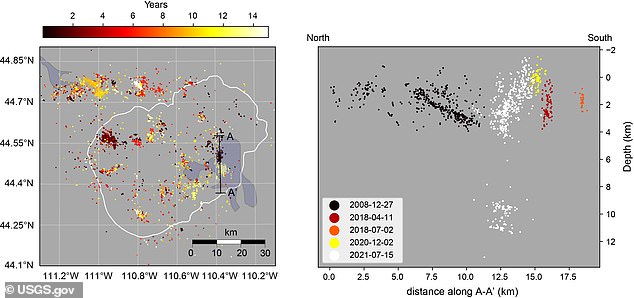
The research team, composed of international experts, utilized AI to analyze 15 years of seismic data from Yellowstone. Their findings uncovered an astonishing 86,000 tiny earthquakes that had gone unnoticed by human experts. This number is approximately ten times higher than what was previously known, highlighting the immense power of machine learning in detecting subtle seismic patterns.
The Role of AI in Seismic Analysis
What sets this study apart from previous efforts is the ability of the AI program to identify every minor tremor and map them on a highly accurate 3D model. This visualization has allowed scientists to observe the "unseen seismic patterns" of Yellowstone, revealing a steady and repeating "heartbeat" of water-driven swarms that occur in specific areas every few years.
These swarms are primarily caused by hot underground water and steam moving through cracks, rather than rising magma. While this discovery does not indicate an immediate threat of eruption, it offers valuable insights into the normal behavior of the volcano. Scientists believe that this AI breakthrough could be critical in detecting hidden earthquake patterns in other volcanoes and fault lines, which may serve as early warning signs of more dangerous events.
Implications for Future Disaster Prediction
The study, published in Science Advances, found that earthquake swarms at Yellowstone do not follow the traditional shock and aftershock pattern. Instead, they occur as clusters of small earthquakes that rapidly spread and shift over a small area within a short period of time. In some cases, these swarms can be linked to molten magma moving upward through the mantle and crust, building pressure that may hint at an upcoming eruption.
However, according to volcano experts, this is not currently the case at the Yellowstone Caldera. Professor Valentin Troll, a volcano expert from Uppsala University in Sweden, stated that these clusters are not associated with deep seismicity, meaning there is no direct evidence of magma recharge from greater depths.
A New Tool for Understanding Volcanic Activity
The researchers emphasized that their findings will serve as a valuable tool for understanding and preparing for future eruptions and major seismic events. By applying similar machine learning techniques to other historical seismic records, scientists can listen to "Earth's volcanic heartbeat" and detect hidden patterns that may have been overlooked.
Dr. Bing Li, a study author, noted that while each volcano has unique features, the insights gained from Yellowstone could be applied elsewhere. "By understanding patterns of seismicity, like earthquake swarms, we can improve safety measures, better inform the public about potential risks, and even guide geothermal energy development away from danger in areas with promising heat flow."
This groundbreaking use of AI not only enhances our ability to monitor volcanic activity but also provides a framework for future research and disaster preparedness. As scientists continue to refine these technologies, the hope is that they will be able to detect early warning signs of potential eruptions or seismic events, ultimately helping to protect communities and save lives.


Comments
Post a Comment