China's Pudu Robotics Launches Global Robot Dog Campaign
Pudu Robotics Unveils D5 at Tokyo Robot Exhibition
At the International Robot Exhibition in Tokyo, a pale-grey, nearly one-metre-tall quadruped robot captured the attention of attendees. The robot, named D5, demonstrated its capabilities by lowering itself down some steps and lifting its right foreleg as if to greet onlookers. It rolled around an exhibition hall on wheels, skillfully avoiding obstacles in its path.
The D5 is the latest model introduced by Chinese robot maker Pudu Robotics at IREX, a biennial industry showcase held at Tokyo Big Sight from December 3 to 6. This marks Pudu's second robot dog model, following a smaller and less agile version released in 2022. Since then, advancements in motion-control algorithms, key components, and embodied intelligence technologies have accelerated across the industry, partly driven by Chinese peers such as Unitree Robotics and Deep Robotics, whose products have helped push robot dogs into real-world settings.
Felix Zhang Tao, founder and CEO of Pudu, highlighted the potential applications of robot dogs during an interview with the Post. "Robot dogs have great application potential, from inspection and delivery to a wide range of industry-specific functions which can be customised, powered by high-performance computing," he said.
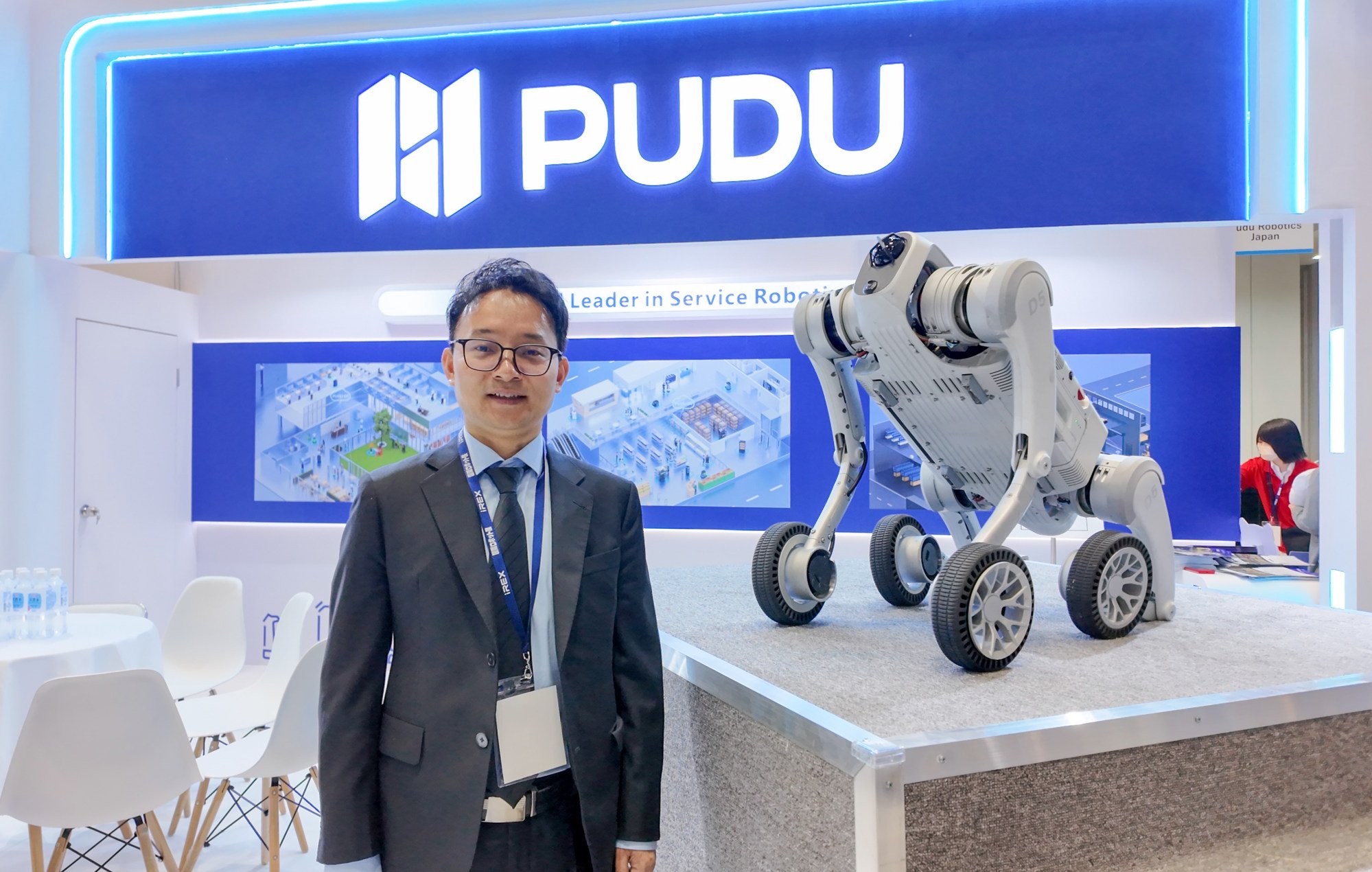
Powered by Nvidia's Orin chip, the D5 is equipped with four 120-degree fisheye cameras and dual front-and-rear lidar sensors. According to the company, it was designed for autonomous, all-terrain, and all-weather operation. Pudu's self-developed joint modules and motors were also integrated into the design.
Shenzhen-based Pudu is known for its extensive lineup of service robots, including those used for food delivery in restaurants and hotels, as well as cleaning and factory logistics machines. The company has sold over 100,000 robots to more than 80 countries and regions so far.
Founded in 2016 by Felix Zhang, who was an engineering student at the Hong Kong University of Science and Technology and a serial entrepreneur with ventures in tech media and unmanned aircraft, Pudu initially targeted restaurant food delivery. Zhang mentioned that the company has built a "global network of more than 700 distributors and after-sales partners." Europe now accounts for around 30% of revenue, with the Americas, Asia-Pacific excluding China, and the mainland each contributing about 20%.
Pudu entered Japan in 2019, forming partnerships with groups such as Skylark and SoftBank. Despite rising political tensions between China and Japan, Zhang stated that these tensions had not affected the company's business.
While Japan has long led in industrial robotics, Chinese companies hold an edge in service robots due to China's abundance of real-world use cases, rapid product iteration, and declining manufacturing costs. Key players in this field include Keenon Robotics, Yunji Technology, and Robint Technology.
Looking ahead, Pudu's next phase involves exploring specialized robots, semi-humanoid robots, and humanoid robots, according to Zhang. China's humanoid-robot sector has seen increased activity in recent years, driven by supportive industrial policies and technological progress.
Leading robot makers have set ambitious targets for 2026, according to a Morgan Stanley research note in December. Orders announced in the second half of this year are already worth more than 2 billion yuan (US$282 million). However, analysts caution that "limited working capability will constrain near-term exponential growth."
After nearly a decade of operations, Pudu is nearing break-even and preparing for an initial public offering, Zhang said. Once a highly sought-after deal for investors, having raised more than 1 billion yuan over at least 10 funding rounds, the company reportedly underwent layoffs and restructuring in 2022.
"Robot penetration is still extremely low," Zhang noted. "We work backwards, from what customers need, and that tells us what kind of robots must be built."
Key Highlights of Pudu Robotics' Journey
- Innovation and Expansion: Pudu Robotics has expanded its reach globally, establishing a network of over 700 distributors and after-sales partners.
- Technological Advancements: The company continues to invest in cutting-edge technologies, such as the Nvidia Orin chip and advanced sensor systems.
- Market Positioning: While Japan leads in industrial robotics, Chinese firms like Pudu are gaining ground in service robots due to practical applications and cost efficiencies.
- Future Goals: Pudu aims to explore specialized and humanoid robots, aligning with broader trends in the robotics industry.
- Challenges and Growth: Despite challenges, including layoffs and restructuring, Pudu remains focused on customer needs and long-term growth.


Comments
Post a Comment