The Vanished Predator of Morocco
The Lost Atlas Bear of North Africa
North Africa once had its own brown bear, the Atlas bear, which is believed to have lived in Morocco's Atlas Mountains until the 19th century. The one and only documented sighting of this beast dates back to 1841 near Tetouan. When thinking of the wild animals that once roamed the Atlas Mountains, most people would quickly name lions, wildcats, or Barbary macaques, but almost never bears. However, bears did exist in Africa, specifically in the form of the Atlas bear.
A Rare Encounter
The last, and perhaps only fully documented, sighting of an Atlas bear occurred in 1841 near Tetouan, recorded by a traveler named Mr. Crowther. On his way to India, passing through Morocco, he reportedly came across the lifeless body of an adult female Atlas bear. According to the book Great and small game of Africa: an account of the distribution, habits, and natural history of the sporting mammals, with personal hunting experiences, “In 1841 a Mr. Crowther… seems to have actually seen a dead specimen, an adult female.”
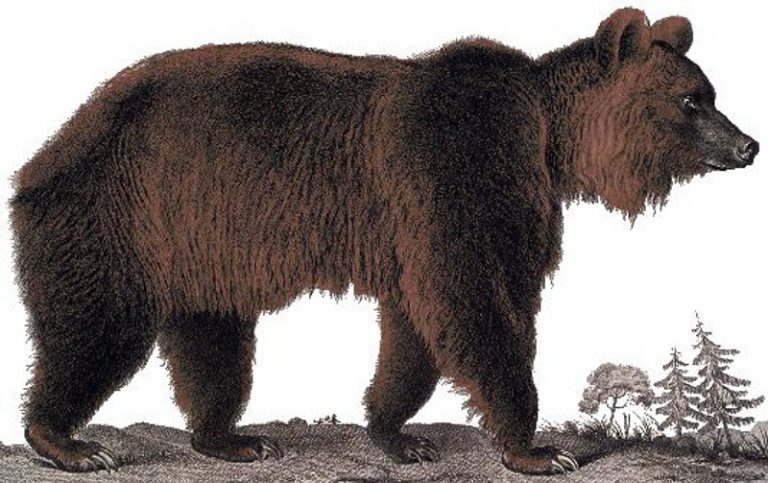
Based on this sighting, the Atlas bear was described as “a little inferior” in size to the American black bear but “more robustly formed.” Its face was shorter and broader, with unusually short but very strong claws. Crowther described the fur as “black, or brownish-black, and shaggy, about 4 or 5 inches (1 inch equals 2.54 centimeters) long; but on the under parts of an orange-rufous colour. The muzzle is black.” He reported that this female bear was killed at the foot of the Tetouan mountains, about 25 miles from the Atlas range. This “was considered, even in 1841, a very rare species in that part, and fed on roots, acorns, and fruits,” reads the same book. Mr. Crowther is believed to have tried to preserve the skin of this Atlas bear but failed before continuing his journey to India.
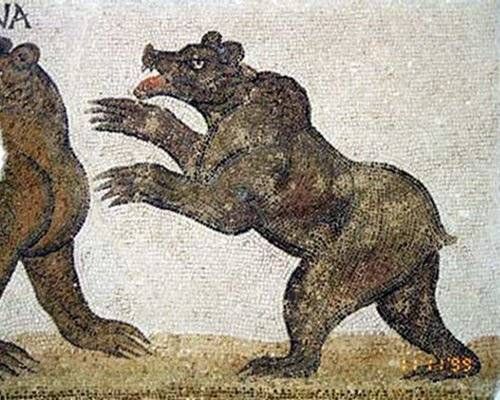
This account became the basis for the scientific description of the species. In 1844, Swiss zoologist Heinrich Rudolf Schinz formally named the Atlas bear Ursus arctos crowtheri, classifying it as a subspecies of Ursus arctos, the same species that includes Eurasian brown bears and North American grizzly bears.
Fossil Evidence and Genetic Studies
Crowther’s story was later supported by fossil discoveries in Moroccan caves, proving that brown bears once lived widely in the region. These bones also helped researchers refine the estimated extinction date, thought to be around the 1860s.
A recent study, Ancient DNA evidence for the loss of a highly divergent brown bear clade during historical times, analyzed remains from El Ksiba Cave in Morocco. It showed that the Atlas bear belonged to a genetically distinct brown bear lineage. One specimen was radiocarbon-dated to 1600 BP, meaning 1600 years before 1950, which corresponds to roughly 350 AD.
Another study from remains found in Ifri Oussaïd cave in the Middle Atlas offered the first isotopic evidence of the Atlas bear’s diet. Researchers found that it was omnivorous, eating a notable amount of animal protein, less herbivorous than some European Holocene bears. Environmental evidence suggests it lived in humid, forested landscapes dominated by plants. Excavations at Ifri Oussaïd unearthed 156 bear bones from at least five individuals, confirming that brown bears lived in Morocco far back into the early–middle Holocene, roughly 8000 years ago.
Legacy and Extinction
The Atlas bear was a unique species that once thrived in the Atlas Mountains of North Africa. Its existence was documented through a single, well-preserved sighting in 1841 and later confirmed through fossil and genetic studies. Despite its resilience, the species eventually disappeared, likely due to habitat loss, human activity, and environmental changes. Today, the Atlas bear is remembered as a symbol of the rich biodiversity that once flourished in North Africa. Its story serves as a reminder of the importance of preserving wildlife and understanding the ecological history of our planet.


Comments
Post a Comment