First Chinese Nobel Laureate in Physics Honored as State Leader

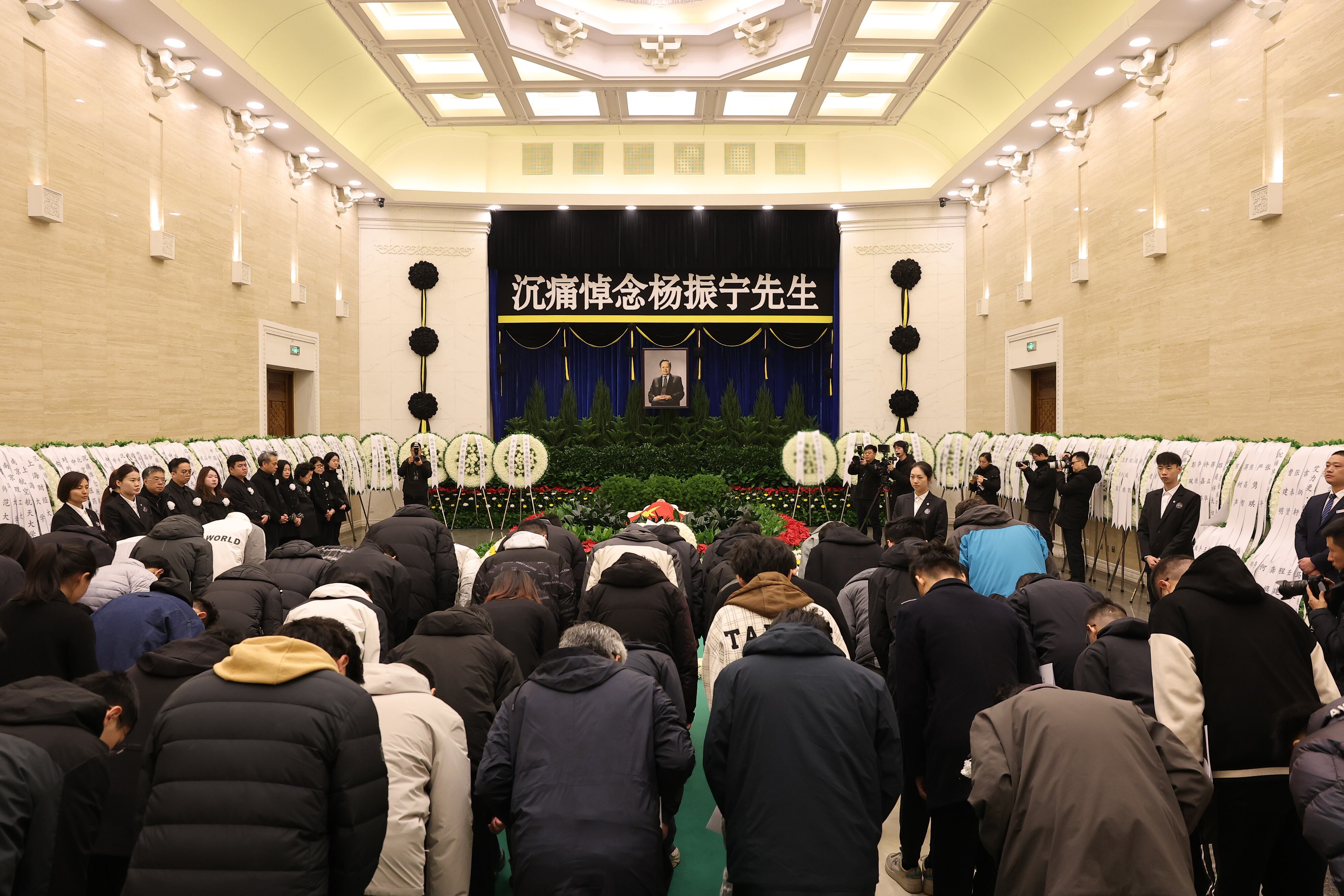
The funeral of the late Yang Zhenning, who passed away at the age of 103, was held at the Yetan (Ceremonial Hall) of the Revolutionary Cemetery on Babaoshan (Eight Treasure Mountain) in Beijing on the morning of the 24th. Citizens arrived early, holding white chrysanthemums and photos of Yang Zhenning, forming a long line that extended to the parking lot. This spontaneous gathering highlighted the deep respect and admiration for the first Chinese Nobel laureate in physics.
Mo Yan, the first Chinese Nobel laureate in literature, expressed his grief in a poem titled "In Mourning for Teacher Yang Zhenning," writing, “He was a guest who descended like an immortal, leaving fragrance for a hundred generations as he departed.”
Babaoshan is a significant location where Chinese leaders and senior national figures are laid to rest. It is uncommon for this site to allow public condolences, which indicates the high regard in which Yang Zhenning was held. Some analysts suggest that the Chinese leadership used this event to demonstrate the nation’s respect for scientists, placing them on par with national leaders.
Major universities and academic institutions in the capital region also created memorial spaces to honor Yang Zhenning. Tsinghua University set up a memorial hall on the first floor of its science building from the 18th to the 24th, allowing citizens and students to pay their respects and leave messages. The Chinese University of Hong Kong also established a condolence space in the history section of its university library, operating from the 23rd to the 30th.
Yang Zhenning was born in Hefei, Anhui Province, in 1922. He graduated from the physics department of the Southwestern Associated University in 1942 and earned a master’s degree from Tsinghua University in 1944. In 1945, he traveled to the United States to study, attending the University of Chicago and the Princeton Institute for Advanced Study.
In 1956, he co-authored the “Parity Non-Conservation Hypothesis” with Li Zhengdao, which led to the Nobel Prize in Physics the following year. This groundbreaking work was so significant that it prompted evaluations stating that “fundamental concepts in physics had been overturned by experiments.” The “Yang-Mills Theory,” proposed with American Robert Mills in 1954, is considered a foundational theory comparable to Einstein’s theory of relativity.
In China, where scientific and technological talent is seen as a core national competitive asset, Yang Zhenning received special treatment. After returning to China from the United States in 2003, he contributed to nurturing young scholars at Tsinghua University. In 2015, he renounced his U.S. citizenship and restored his Chinese nationality. This period coincided with China’s increased efforts to attract overseas scholars, during which figures like Yao Qi, a Tsinghua University professor and Turing Award winner, also acquired Chinese nationality around the same time.
Tsinghua University, where Yang Zhenning was affiliated, stated, “Leaders of the party and state, bereaved family members, his friends from his lifetime, all members of Tsinghua University, and figures from all sectors of society bid farewell to Yang Zhenning.” There are also suggestions that the Chinese leadership may posthumously confer state-level medals or honorary titles on the late scientist.


Comments
Post a Comment