Nvidia Expands H200 Output Amid Chinese Market Uncertainty
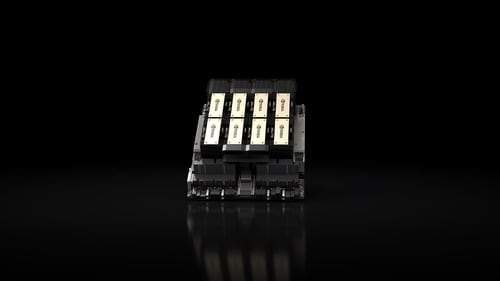
Nvidia's H200 Chip Production Expansion
Nvidia is reportedly planning to ramp up the production of its AI chip, the H200, following recent export approvals to China. According to a report by Reuters, local time on the 12th, the company is considering increasing output as demand from Chinese clients has surpassed current capacity. This development comes just four days after the Trump administration announced its decision to permit the export of the H200 to China.
The report highlights that Chinese companies have shown significant interest in the H200, with major tech firms like Alibaba and ByteDance already engaging in discussions with Nvidia about bulk purchases. The H200 is based on the previous-generation 'Hopper' architecture and is considered the most powerful chip in that series. While it does not match the performance of the latest 'Blackwell'-based chips, it is notably more advanced than the lower-spec 'H20' chip, which is currently approved for export to China.
Despite this, there are ongoing uncertainties regarding the import of the H200 into China. The Chinese government has held an emergency meeting to discuss the matter and is expected to make a final decision soon. This uncertainty is compounded by conflicting statements from U.S. officials. Although President Donald Trump had previously claimed that Chairman Xi responded positively to the approval of H200 exports, some forecasts suggest that the Chinese government may ultimately reject the import of the chip.
David Sacks, the White House science and technology advisor and 'AI Czar' overseeing the Trump administration’s AI strategy, stated in an interview with Bloomberg Tech that China is rejecting U.S. chips due to its desire for self-sufficiency in semiconductors. He explained that the U.S. aimed to sell older, non-state-of-the-art chips to China to gain market share from Huawei. However, he noted that the Chinese government recognized this strategy and thus refused to allow chip imports.
This situation reflects China's broader goal of achieving self-reliance in AI chip technology. As the U.S. imposed stricter export controls on AI chips to China, companies like Huawei have accelerated their efforts to develop domestic AI chip technology, including the 'Ascend' series. However, concerns persist that if U.S. AI chips such as the H200 enter China again, Chinese companies might rely on American products, potentially hindering the development and sales of locally produced AI chips.
Bloomberg reported that China is considering an incentive package worth up to $70 billion (approximately 1.03 trillion Korean won) to support its domestic semiconductor industry. This move underscores the country's commitment to reducing its dependence on foreign technology and strengthening its position in the global AI chip market.
Key Points
- Production Increase: Nvidia is looking to increase H200 chip production due to high demand from Chinese clients.
- Export Approval: Recent U.S. approval allows the H200 to be exported to China, though the Chinese government has not yet decided on importing the chip.
- Chinese Tech Giants: Companies like Alibaba and ByteDance have expressed interest in purchasing the H200 in bulk.
- Performance Comparison: The H200 is more powerful than the H20 but lags behind the latest Blackwell-based chips.
- Uncertainty: The Chinese government is still deliberating whether to permit the import of the H200.
- U.S. Strategy: The Trump administration aimed to sell older chips to China to gain market share, but this was seen through by the Chinese government.
- Self-Sufficiency Goals: China seeks to achieve self-reliance in AI chip technology, leading to increased investment in domestic semiconductor development.
- Incentive Package: China is considering a substantial financial incentive to boost its domestic semiconductor industry.


Comments
Post a Comment