KFTC Fines Woomi 48.4 Billion Won for Unfair Affiliate Practices
Unfair Allocation of Construction Projects by Woomi
The Korea Fair Trade Commission (KFTC) has recently imposed a penalty of 48.379 billion Korean won on the mid-sized conglomerate group 'Woomi' for its unfair allocation of approximately 500 billion Korean won worth of construction projects to its affiliates. This included a company owned by the second-generation leader, without any reasonable justification. The KFTC also decided to refer Woomi Construction to prosecutors. According to the commission, Woomi undermined the fair transaction order in the housing construction market by directing a large number of apartment construction projects to its affiliates. Additionally, over 10 billion Korean won in unjust wealth transfer occurred to the second-generation leader through LH (Korea Land and Housing Corporation)'s public land bid process.
According to the KFTC, Woomi, which owns the apartment brand ‘Lynn’, is suspected of selecting five affiliates with no housing construction track record as non-primary contractors for 12 apartment construction sites it managed from 2017, providing them with 499.7 billion Korean won worth of projects. Typically, developers have the right to select contractors, but Woomi allegedly arbitrarily chose its affiliates to help them build construction records.
This support was triggered by LH’s 2016 revision of its public land bid system. To prevent so-called 'swarm bidding'—where construction companies mobilize multiple affiliates to increase their chances of winning land supply rights—LH added a requirement of '300 housing units of construction track record' for first-priority bids. Woomi allegedly began unfairly supporting its affiliates to meet this requirement.
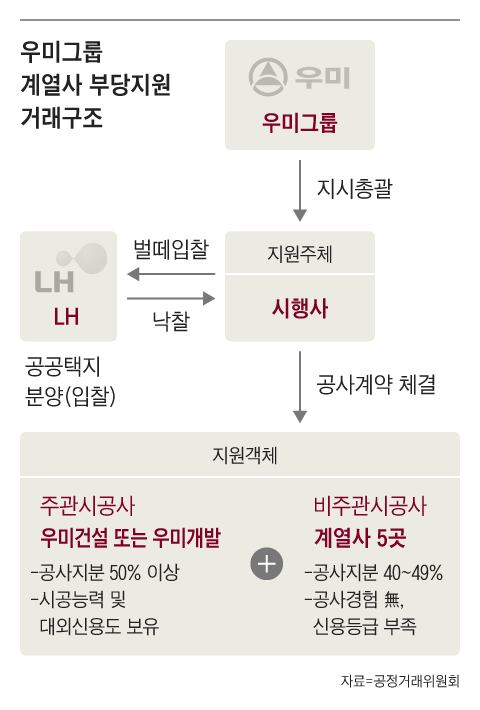
Notably, Woomi was found to have systematically planned and executed this support at the group level. When selecting contractors, it prioritized affiliates that paid the least taxes, regardless of their construction capabilities. It also designated companies without construction licenses as contractors and temporarily transferred employees from other affiliates to enable inexperienced affiliates to carry out projects.
The KFTC determined that Woomi’s unfair support disrupted fair transaction order in the housing construction market and unjustly benefited the second-generation leader by over 10 billion Korean won. The five affiliates secured approximately 500 billion Korean won in construction sales, growing into mid-sized construction companies with annual sales exceeding 50 billion Korean won. For instance, Woomi Estate, which ranked 5,402nd in construction capability evaluation before the support, jumped to 35th afterward.
After securing sufficient construction track records, the five companies unfairly participated in 275 public land bids, benefiting the group. Woomi Estate and Simwoo General Construction won two additional land sites in 2020, while Woomi added 726.8 billion Korean won in sales and 129 billion Korean won in gross profit from two land developments. Notably, Woomi Estate was established in June 2017 by the second-generation leader’s two children (Lee Seok-jun, vice chairman’s children, Lee Seung-hoon and Lee Seung-hyun) with 1 billion Korean won in capital. It received 88 billion Korean won worth of projects within four months of its founding due to internal support. The second-generation leader later sold Woomi Estate’s shares to Woomi Development in 2022, securing a 11.7 billion Korean won profit within five years of its establishment. The KFTC judged this as an unjust wealth transfer to the leader’s family.
The KFTC ruled Woomi’s actions as unfair support under the Fair Trade Act, issuing a corrective order and imposing a 48.379 billion Korean won penalty. It also decided to refer Woomi Construction, which played a central role in the group’s decisions, to prosecutors. Previously, the KFTC imposed penalties of 60.8 billion Korean won on Hoban Construction Co. (2023) and 20.5 billion Korean won on Daebang Construction (February 2025) for similar 'swarm bidding' violations.


Comments
Post a Comment